
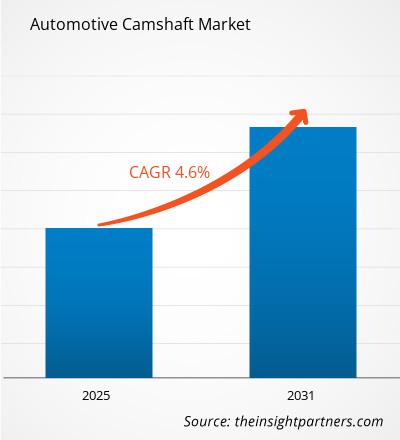
As an essential component of internal combustion engines (ICEs), the automotive camshaft controls the opening and closing of engine valves, regulating air-fuel intake and exhaust emission timings. The demand for camshafts remains tightly connected to global vehicle production levels, ongoing developments in engine performance optimization, and stringent environmental regulations governing fuel efficiency and carbon emissions.
The global Automotive Camshaft Market size is projected to reach US$ 4.25 billion by 2034 from US$ 3.26 billion in 2025. The market is anticipated to register a CAGR of 3.00% during the forecast period 2026-2034.
Key Drivers Fueling Market Growth
-
Demand for Fuel Efficiency and Emission Control- Governments across North America, Europe, and Asia-Pacific have implemented strict emission standards (such as Euro 6/Euro 7 and CAFE regulations). Automotive manufacturers are continuously optimizing valve timing through advanced variable valve timing (VVT) systems, which rely heavily on specialized camshaft designs to maximize fuel efficiency and reduce harmful emissions.
-
Rising Global Vehicle Production- Despite the rapid adoption of electric vehicles (EVs), internal combustion engine (ICE) and hybrid electric vehicles (HEVs) continue to dominate total automotive sales worldwide. The growth of commercial vehicles and passenger cars in emerging economies across Asia-Pacific and Latin America provides steady support for the ongoing demand for automotive camshafts.
-
Innovations in Lightweight Materials- Engineers are increasingly shifting from conventional cast iron camshafts to assembled and forged steel camshafts. Lightweight camshafts reduce engine inertia, enhance fuel efficiency, and lower thermal stresses, thereby extending component lifespan while meeting modern performance requirements.
Market Segmentation Highlights
-
By Type: The market is categorized into cast camshafts, forged camshafts, and assembled camshafts. Assembled camshafts are experiencing accelerating growth due to their lighter weight and flexibility in using different materials for lobes and shafts.
-
By Vehicle Type: Segments include passenger cars, light commercial vehicles (LCVs), and heavy commercial vehicles (HCVs). Passenger cars hold a major share, while the commercial vehicle sector drives demand for durable, heavy-duty forged components.
-
By Distribution Channel: Divided into Original Equipment Manufacturers (OEMs) and the aftermarket sector. OEMs hold the dominant market share due to direct integration during vehicle assembly.
Get a PDF Sample- https://www.theinsightpartners.com/sample/TIPAT100001341
Key Market Players
The market features established component manufacturers and technology leaders focused on product innovation, strategic partnerships, and material enhancements. Key market players include:
-
Melling Engine Parts
-
LACO camshafts
-
Sandvik Coromant
-
MAHLE GmbH
-
Schrick Camshaft
-
Meritor, Inc.
-
Piper RS Ltd
-
Kautex Textron GmbH & Co. KG
-
ThyssenKrupp
-
Estas Camshaft
These companies actively invest in precision machining solutions, lightweight material engineering, and surface-coating technologies to ensure superior wear resistance and operational reliability under extreme thermal conditions.
Regional Insights
-
Asia-Pacific: Represents the largest and fastest-growing regional market, propelled by high vehicle manufacturing outputs in China, India, and Japan. Expansion in urban logistics and increasing consumer purchasing power further boost local demand.
-
North America: Characterized by high demand for light commercial vehicles, pickup trucks, and high-performance passenger cars. Technological integration in VVT systems drives aftermarket and OEM supply chains.
-
Europe: Heavily focused on meeting decarbonization targets. European manufacturers prioritize advanced assembled camshafts and hybrid powertrains to align with regional environmental mandates.
Get Full Copy of This Report- https://www.theinsightpartners.com/buy/TIPAT100001341
Future Outlook
The future of the global automotive camshaft market lies in continuous adaptation to evolving powertrain technologies. While full battery electric vehicles (BEVs) do not require camshafts, the sustained market presence and rising adoption of hybrid electric vehicles (HEVs and PHEVs)—which combine internal combustion engines with electric drivetrains—ensure ongoing demand for advanced camshaft solutions over the next decade. Industry players are projected to focus heavily on lightweight assembled camshaft designs, automated precision manufacturing, and friction-reducing surface treatments to maximize thermal efficiency in modern hybrid engines. Consequently, steady growth across commercial vehicle fleets and hybrid passenger segments will keep the market resilient through 2034.
Related Reports-
Automotive Turbocharger Market
About Us
The Insight Partners is a one-stop industry research provider of actionable intelligence. We help our clients in getting solutions to their research requirements through our syndicated and consulting research services. We specialize in industries such as Semiconductor and Electronics, Aerospace and Defense, Automotive and Transportation, Biotechnology, Healthcare IT, Manufacturing and Construction, Medical Devices, Technology, Media, and Telecommunications, as well as chemicals and Materials.
Contact Us
If you have any queries about this report or if you would like further information, don’t hesitate to get in touch with us:
Contact Person: Ankit Mathur
E-mail: ankit.mathur@theinsightpartners.com

