Barcode label printers have become essential tools for inventory management, product identification, asset tracking, healthcare labeling, logistics, manufacturing, and retail operations. These printers enable organizations to produce accurate, high-quality barcode labels that improve operational efficiency, regulatory compliance, and supply chain visibility. As businesses continue embracing warehouse automation, omnichannel retail, industrial digitalization, and traceability requirements, demand for reliable barcode label printing solutions continues to expand across multiple industries.
Market Overview
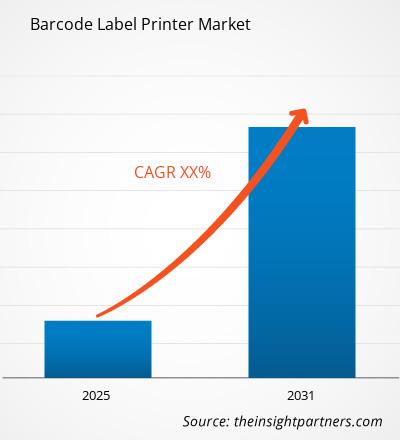
The Barcode Label Printer Market was valued at US$ 5.84 Billion in 2025 and is projected to reach US$ 11.62 Billion by 2034, registering a CAGR of 7.95% during the forecast period 2026–2034. Market growth is driven by increasing adoption of warehouse automation, rising demand for serialized labeling, expanding e-commerce logistics, healthcare traceability regulations, and growing investments in supply chain digitization. Continuous innovation in cloud-connected printing, RFID integration, and mobile printing technologies is further accelerating market expansion.
Key Market Insights
- Market Size (2025): US$ 5.84 Billion
- Forecast Market Size (2034): US$ 11.62 Billion
- CAGR (2026–2034): 7.95%
- Key Growth Driver: Rising adoption of automated inventory management and product traceability solutions
- Major Trend: Increasing deployment of cloud-connected, RFID-enabled, and mobile barcode printing technologies
- Forecast Period: 2026–2034
Get a Sample PDF of the Report: https://www.theinsightpartners.com/sample/TIPRE00010527
Market Drivers
Expansion of Warehouse Automation
Growing investments in warehouse automation, smart distribution centers, and fulfillment operations are driving demand for high-performance barcode label printers that support accurate inventory tracking and logistics management.
Increasing Product Traceability Requirements
Manufacturers, healthcare providers, and government organizations are adopting serialized labeling systems to improve product authentication, regulatory compliance, and supply chain transparency.
Growth of E-commerce Logistics
Rapid expansion of e-commerce and omnichannel retail is increasing the need for efficient shipping, return, shelf, and compliance labeling across fulfillment centers and distribution networks.
Healthcare Labeling and Patient Safety
Hospitals and healthcare providers continue investing in barcode labeling technologies to improve patient identification, medication administration, specimen tracking, and medical device traceability.
Market Trends
Growth of Mobile Barcode Printing
Demand for rugged mobile barcode printers is increasing as field workers, warehouse personnel, and retail employees require portable labeling capabilities.
Cloud-Based Printer Management
Organizations are adopting cloud-enabled printer management platforms that simplify remote configuration, monitoring, maintenance, and software updates across distributed operations.
RFID Integration
Manufacturers are introducing barcode printers with integrated RFID encoding capabilities to improve inventory visibility, asset tracking, and supply chain automation.
Enhanced Printer Durability
Vendors continue developing industrial-grade barcode printers with longer printhead life, improved reliability, and lower maintenance requirements for demanding operating environments.
Get the Premium Research Report @ https://www.theinsightpartners.com/buy/TIPRE00010527
Regional Analysis
North America
North America accounted for approximately 34%–36% of the global market in 2025 and is projected to grow at a CAGR of 6.8%–7.4% during 2026–2034. Market growth is supported by warehouse automation, healthcare product traceability, retail replenishment systems, and expanding logistics infrastructure. The US represented approximately 78%–82% of North America’s market in 2025 and is expected to register a CAGR of 6.9%–7.5%, driven by omnichannel retail, healthcare labeling, government procurement systems, and advanced supply chain management.
Europe
Europe held approximately 24%–27% of the market in 2025 and is anticipated to grow at a CAGR of 6.2%–6.9%. Germany, the UK, France, Italy, and Spain continue investing in industrial automation, manufacturing digitalization, healthcare infrastructure, and logistics modernization.
Asia-Pacific
Asia-Pacific captured approximately 28%–31% of the global market in 2025 and is projected to register the fastest regional growth with a CAGR of 8.7%–9.6% during 2026–2034. China, Japan, South Korea, India, and Australia continue expanding manufacturing capacity, e-commerce operations, logistics infrastructure, and industrial automation, creating significant opportunities for barcode label printer manufacturers.
Middle East and Africa
The Middle East and Africa are experiencing increasing investments in logistics infrastructure, retail modernization, healthcare digitization, and public sector digital transformation, supporting growing adoption of barcode labeling technologies.
Segment Analysis
By Product Type
The Industrial Printers segment accounted for approximately 46%–50% of the market in 2025 and is projected to grow at a CAGR of 7.1%–7.8% through 2034. High durability, continuous operation, and reliable performance in manufacturing, warehousing, and logistics environments continue supporting the segment’s market leadership.
By Product Type
The Mobile Printers segment represented approximately 18%–22% of the market in 2025 and is expected to register the fastest growth with a CAGR of 9.1%–10.2%. Rising demand for portable printing in field services, retail, transportation, healthcare, and warehouse operations continues accelerating market adoption.
Competitive Landscape
The Barcode Label Printer Market remains highly competitive as automatic identification and data capture (AIDC) technology providers, industrial printing manufacturers, and enterprise mobility companies continue investing in next-generation printing technologies. Companies are strengthening their competitive positions through innovations in RFID-enabled printers, cloud-based printer management, wireless connectivity, durable printheads, enterprise software integration, and intelligent label management solutions. Strategic collaborations with retailers, logistics providers, healthcare organizations, manufacturers, and system integrators continue accelerating technology adoption across global supply chains.
Key Players
- Gainscha Technology Group Co., Ltd.
- GoDEX International Co., Ltd.
- Honeywell International Inc.
- Postek Electronics Co., Ltd.
- SATO Holdings Corporation
- Seiko Epson Corporation
- Toshiba Tec Corporation
- TSC Auto ID Technology Co., Ltd.
- Wasp Barcode Technologies
- Zebra Technologies Corporation
Emerging Trends
The barcode label printer industry is advancing through RFID-enabled printing, cloud-based printer administration, mobile printing technologies, wireless connectivity, intelligent print management software, industrial IoT integration, durable thermal printheads, automated label verification, enterprise mobility solutions, and sustainable printing technologies. Manufacturers are developing next-generation barcode printing platforms that deliver higher print accuracy, faster processing speeds, lower maintenance costs, improved connectivity, and seamless integration with warehouse management systems, enterprise resource planning platforms, RFID infrastructure, and supply chain automation solutions. These technological advancements are expected to create significant growth opportunities across manufacturing, retail, healthcare, transportation, logistics, government, and industrial sectors throughout the forecast period.
Future Outlook
The future outlook for the Barcode Label Printer Market remains strong as organizations continue investing in digital supply chains, warehouse automation, healthcare traceability, and intelligent inventory management systems. Continued innovation in mobile printing, RFID technology, cloud connectivity, and industrial automation is expected to support sustained market growth through 2034.
Related Market Research Reports
RF Power Amplifier Market Drivers and Trends by 2031
Microprocessor Market Growth Report and Size by 2030
Smart Glass Market Growth, Trends & Forecast by 2034
Scroll and Absorption Chillers Market Size, Trends & Growth by 2034
About The Partners
The Insight Partners is a Insight global leader in market research, delivering comprehensive analysis and actionable insights across diverse industries. The company empowers decision-makers with data-driven intelligence to navigate evolving markets and accelerate growth.
Contact Us:
- Contact Person: Ankit Mathur
- E-mail: ankit.mathur@theinsightpartners.com
- Phone: +1-646-491-9876
Also Available in :