Key Highlights
-
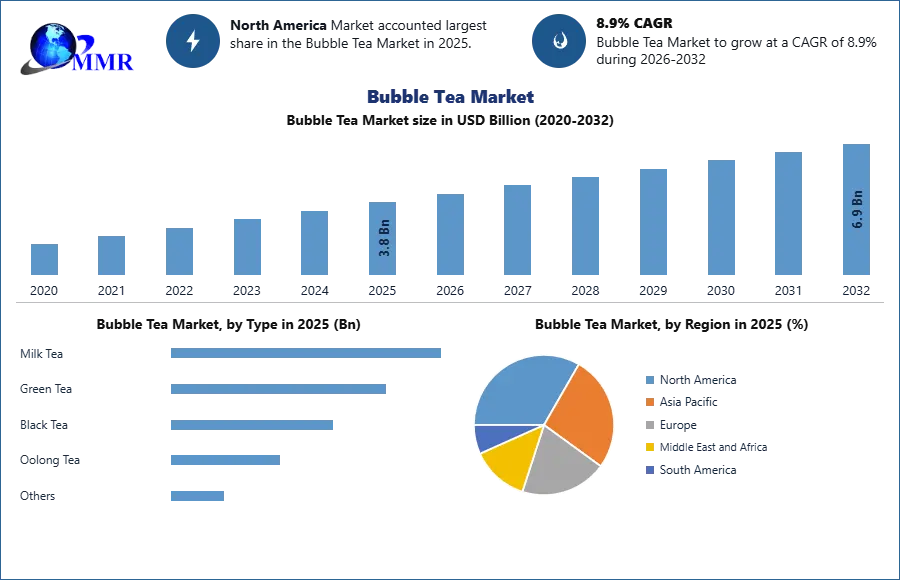
The global bubble tea market achieved an industry valuation of USD 3.8 billion in 2025 and is projected to expand to USD 6.91 billion by 2032, recording a strong compound annual growth rate (CAGR) of 8.9%.
-
The black tea type segment maintained structural dominance, commanding a market share of over 45% in 2025 due to its distinct natural flavor profile and recognized physiological wellness properties.
-
Classic flavor formulations (original black tea blended with milk and sugar) operate as the leading flavor category, maintaining peak popularity across both adolescent and mature buyer cohorts.
-
North America anchored the global market footprint in 2025, generating a dominant USD 1,429.3 million in revenue due to rapid lifestyle adoption and deep retail store availability.
-
Asia Pacific holds the second-leading share of the global market at 35%, driven by high per-capita volume consumption, led by Thailand’s regional average of six cups per user per month.
-
Health-related production hurdles persist, as the over-use of heavy sugar syrups and artificial sweeteners causes dental decay and low immunity concerns that trigger regulatory scrutiny.
Why This Matters Now
Legacy soda brands and carbonated beverage manufacturers face immediate volume losses as global youth demographics systematically desert traditional sweet soft drinks. Beverage category executives cannot view texturized tea formulas as a passing mall-kiosk novelty. It has transformed into a major functional asset class capable of pulling multi-million-dollar consumer food spend away from standard ready-to-drink portfolios.
The baseline financial survival of modern beverage lines depends on capturing early positions in specialty café categories. As multinational brands begin weaponizing their large-scale production setups to ship retail boba hybrids, independent café chains face margin compression. Corporate operators must secure reliable agricultural ingredient supply chains to protect their margins from sudden price spikes in raw tapioca and specialized tea stocks.
Market Overview
The global bubble tea market recorded an industrial valuation of USD 3.8 billion in 2025. Continuous commercial investments in franchise networks and automated retail beverage equipment will drive total market revenue to USD 6.91 billion by 2032. This long-term expansion maintains a steady 8.9% CAGR throughout the 2026 to 2032 forecast window.
The underlying industrial marketplace centers on the formulation of specialized tea bases combined with milk, ice, flavor-infused syrups, and distinct texturized additions like tapioca pearls. Retail operators rely on automated high-shear shaking systems to thoroughly integrate liquid layers, ensuring a uniform taste profile and immediate visual appeal. Final products serve diverse demographic profiles, categorized primarily into Milk Tea, Green Tea, Black Tea, and Oolong Tea types.
𝐃𝐨𝐰𝐧𝐥𝐨𝐚𝐝 𝐏𝐃𝐅 𝐁𝐫𝐨𝐜𝐡𝐮𝐫𝐞 @ https://www.maximizemarketresearch.com/request-sample/110228/
Key Trends Driving Growth
The massive expansion of specialty tea and coffee drinking habits worldwide is altering basic consumer beverage spending patterns. Shifting consumer choices show a deep preference for customizable beverages that offer optional flavor additions, varied sweetness tiers, and interactive chewable textures. This consumption pattern is exceptionally strong among teenagers and young adults, who treat boba purchases as an everyday social activity.
Global Bubble Tea Market Structural Baseline (2025 Asset Status)
┌───────────────────────┬───────────────────────────┬──────────────────────────────────┐
│ Segment Category      │ Baseline Performance Fact │ Core Commercial Driver           │
├───────────────────────┼───────────────────────────┼──────────────────────────────────┤
│ Black Tea (Product)   │ Over 45% Market Share     │ Natural flavor & health benefit  │
│ North America (Region)│ USD 1,429.3 Million Base  │ Swift retail franchise expansion │
│ Asia Pacific (Region) │ 35% Global Market Share   │ High per-capita youth consumption│
└───────────────────────┴───────────────────────────┴──────────────────────────────────┘
Concurrently, scientific documentation regarding the health benefits of unflavored tea bases is attracting older, affluent consumer groups. Active shoppers aged 28 to 50 are choosing sugar-free black bubble tea options due to their verified ability to lower harmful cholesterol, regulate blood sugar spikes, and improve intestinal health. This health trend allows brands to split their marketing strategies, selling premium functional teas to adults while capturing younger shoppers with sweeter fruit variants.
Furthermore, pop-culture-focused marketing plans and joint brand campaigns are expanding retail sales velocity. Leading bubble tea chains regularly partner with toy brands, animation studios, and gaming companies to release limited-edition drinks and themed packaging. This strategy creates immediate purchasing urgency among younger consumers, lifting same-store sales figures above typical fast-food averages.
Segment Insights
-
Black Tea (Dominant Segment): Controlled a dominant market share of over 45% across all varieties in 2025. Its natural flavor profile and functional antioxidants make it the preferred choice for both wellness-seeking adults and health-conscious youth.
-
Classic Flavour (Dominant Segment): Dominates the flavor category across all regions. The original blend of black tea, milk, and sugar remains the top operational revenue source for international franchise networks due to its broad consumer appeal.
-
Next-Generation Flavors (Fastest-Growing Segment): Emerging options including chocolate, vanilla, and mixed berries are recording rapid sales gains, expanding menu varieties across mainstream malls.
-
Europe (Fastest-Growing Region): Anticipated to log the highest compound annual growth rate over the forecast window, driven by a sudden surge in specialized tea shops across urban European centers.
Regional Growth Story
North America dominated the global bubble tea market in 2025, generating a leading USD 1,429.3 million in revenue. This dominant regional position relies on an expansive footprint of franchise networks, swift consumer adoption rates, and a highly advanced fast-casual dining ecosystem across the United States and Canada. The region is projected to maintain its market edge through 2032 as local brands expand their delivery app networks to capture more suburban demand.
Concurrently, the Asia Pacific region secures the second-largest global position, controlling a stable 35% market share. Consumption metrics remain exceptionally dense across Southeast Asian metros, where local consumers view boba tea as a core lifestyle staple. Foodservice tracking shows that Thai consumers lead regional volume trends with an average consumption of six cups per user per month, followed closely by steady purchasing habits in Malaysia, Singapore, Indonesia, and Vietnam.
Competitive Landscape
The global bubble tea market is transitioning from a highly fragmented landscape of local independent shops into a consolidated corporate arena run by multi-thousand-unit global chains. Leading market participants compete directly on store count growth, supply chain security, and multi-channel advertising. Success in this environment requires maintaining identical drink quality across massive, multi-national franchise networks while absorbing rising lease and labor costs.
This hyper-competitive environment creates intense pressure for mid-tier brands that lack direct ingredient manufacturing assets. Large chains lower their unit costs by operating dedicated tapioca processing plants and centralized syrup blending facilities, allowing them to win local price wars. Over the next 12 to 24 months, expects corporate consolidation as massive global store networks acquire smaller regional competitors to instantly secure prime real estate locations.
Recent Developments
-
On 25 March 2026, Mixue Group reported a 35% revenue increase for 2025, hitting 33.6 billion yuan and securing its status as the world’s largest bubble tea operator with a global store count exceeding 55,000 outlets.
-
On 15 December 2025, HeyTea executed a large-scale strategic collaboration with POP MART, launching exclusive toy-themed seasonal drinks that drove a 28% increase in same-store retail sales.
-
On 10 November 2025, The Coca-Cola Company officially launched Cappy Bubble, a specialized boba-juice hybrid drink line designed to enter the ready-to-drink specialty tea ecosystem.
-
On 15 September 2025, CoCo Bubble Tea finalized a long-term supply agreement to secure sustainably sourced tea leaves, stabilizing bulk raw material inventory metrics for its international outlets.
Strategic Implications
Mixue Group’s massive revenue numbers prove that low-cost, high-volume franchise strategies can successfully beat out competitors even during intense domestic price wars. Operating tens of thousands of locations allows top-tier chains to dictate wholesale packaging and ingredient pricing globally, making it difficult for independent operators to survive on thin margins. Competing brands must quickly scale their store counts or invest in unique product differentiation to avoid getting crowded out of prime retail locations.
At the same time, Coca-Cola’s launch of Cappy Bubble signals a major structural shift as multinational beverage giants begin competing directly with retail tea chains. Entering the market with shelf-stable boba hybrids allows mass-market manufacturers to leverage their global grocery store shelf placements, bypassing the high costs of running physical storefronts. This development will force traditional café franchises to improve their mobile ordering setups and emphasize their fresh, hand-made quality to protect consumer loyalty.
Future Outlook
Nutritional safety challenges remain a primary obstacle to long-term market expansion, as public health campaigns expose the high calorie counts linked to excessive synthetic syrup usage. Furthermore, bubble tea operations face strict regional restrictions on single-use plastic straws and cups, requiring continuous corporate spending on biodegradable packaging options. This environmental compliance pressure keeps initial franchise startup costs high, limiting expansion rates in cost-sensitive markets.
Navigating this changing environment requires a clear dual focus on menu health reformulations and digital customer tracking. Beverage brands must reduce their reliance on artificial sweeteners by introducing organic stevia options and fresh fruit extracts to retain health-conscious adult buyers. Organizations that master fast mobile app ordering while cleaning up their ingredient profiles will capture dominant market shares, while unhedged bulk operators relying strictly on high-sugar commodities will face margin compression.
Analyst Perspective
“We are tracking an unmistakable change as the global bubble tea market evolves from a trendy youth product into a permanent segment of the global beverage industry. The dominant 45% market share held by black tea proves that consumers want real, premium tea bases alongside interactive textures. The future belongs to brands that can balance high-volume franchise operations with modern clean-label demands, using natural fruit juices and lower sugar levels to capture older, high-spending demographics.” — Siddhi Dole, Research Analyst, Maximize Market Research
About Maximize Market Research
Maximize Market Research Pvt. Ltd. (MMR) is a global market research and consulting company that provides reliable, data-focused, and practical business insights. The firm serves a wide range of industries, including healthcare, pharmaceuticals, technology, automotive, electronics, chemicals, personal care, and consumer goods. Through market forecasts, competitive analysis, strategic consulting, and industry impact assessments, MMR helps organizations understand changing market conditions, identify growth opportunities, and make informed business decisions for long-term success.
2nd Floor, Navale IT Park Phase 3
Pune Banglore Highway, Narhe
Pune, Maharashtra 411041, India
+91 9607365656
sales@maximizemarketresearch.com