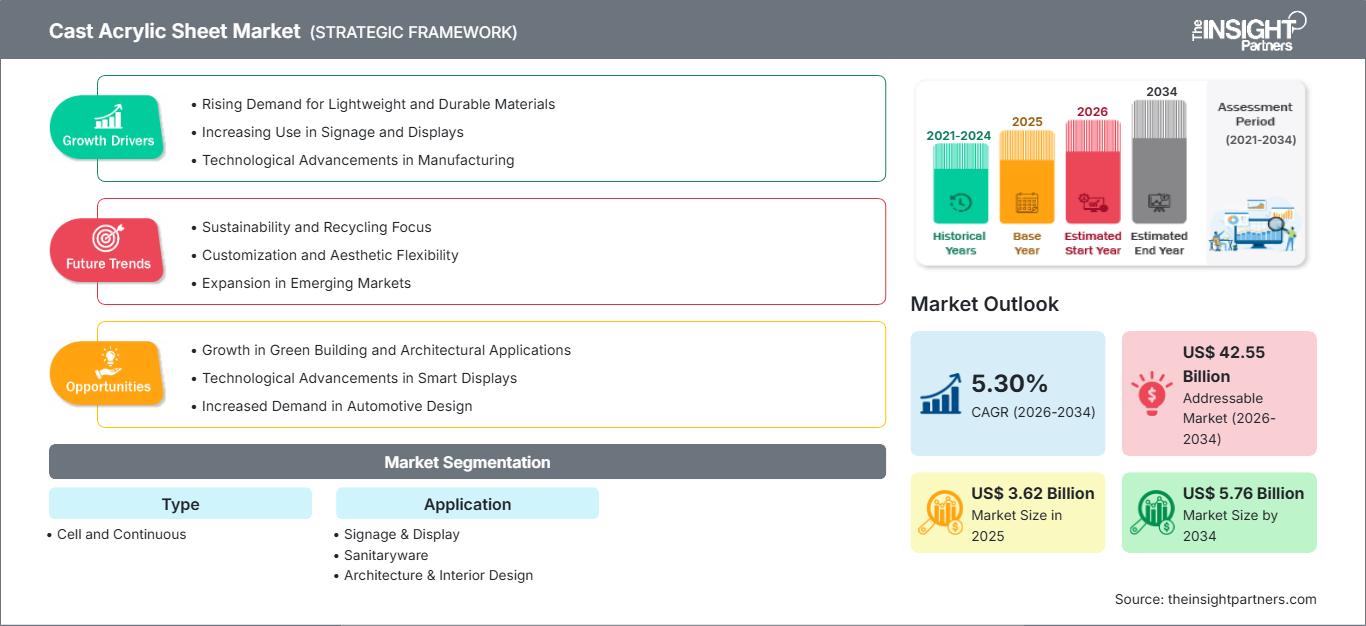
Retail storefronts, hospital equipment, and vehicle interiors are quietly converging on the same material choice, and it is not glass. The Cast Acrylic Sheet Market is valued at US$ 3.62 Billion in 2025 and is forecast to reach US$ 5.76 Billion by 2034, growing at a 5.30% CAGR through the 2026 to 2034 period. Optical clarity, impact resistance, and design flexibility are pulling cast acrylic sheet into more applications every year, and manufacturers are racing to keep pace with demand that spans signage, sanitaryware, and transportation alike.
What Is the Cast Acrylic Sheet Market?
Cast acrylic sheet is produced by polymerising liquid acrylic monomer between glass plates, yielding a material with superior optical clarity, weather resistance, and thickness consistency compared with extruded acrylic. It is manufactured in cell and continuous casting formats and used across signage, sanitaryware, architecture, transportation, medical, and food and catering applications where glass-like clarity without glass’s weight or fragility is required.
Request a Sample Copy of the Report: https://www.theinsightpartners.com/sample/TIPRE00040596
Market Drivers
Retail and advertising are among the strongest forces behind cast acrylic sheet demand. Brands competing for shopper attention increasingly favour illuminated signage and premium point-of-purchase displays, and cast acrylic delivers the light diffusion and edge-polish quality that extruded alternatives struggle to match. As out-of-home advertising and experiential retail formats expand across Asia Pacific and the Middle East, converters are scaling up cast lines to keep pace with order volumes.
Architecture and interior design is a second major pull. Designers are specifying cast acrylic for skylights, partitions, and decorative panelling, drawn by its ability to be thermoformed into curved and sculptural shapes without losing clarity. What makes this particularly significant is how sustainability-conscious building codes are favouring lightweight materials that reduce structural load, a category where cast acrylic sheet competes well against both glass and polycarbonate.
Sanitaryware manufacturing continues to lean on cast acrylic for bathtubs, basins, and shower panels, where its ability to be moulded into complex three-dimensional forms while resisting staining and yellowing gives it a durable edge over cheaper alternatives. Transportation applications, spanning aircraft windows, rail interiors, and marine glazing, are also expanding steadily, since cast acrylic offers a favourable strength-to-weight ratio that helps operators meet fuel efficiency and weight reduction targets.
Healthcare and food and catering round out the demand base. Hospitals use cast acrylic for protective barriers and equipment housings that must tolerate repeated sanitisation, while the food service sector relies on it for display cases and counter fixtures that need to stay crystal clear under constant handling. Beyond these individual sectors, a common thread runs through all of them: buyers across industries are trading glass for acrylic wherever weight, safety, or design flexibility matters more than raw cost.
Segmentation Overview
By Type: Cell cast acrylic sheet dominates the market on the strength of superior optical clarity and thickness uniformity, making it the preferred choice for premium signage, sanitaryware, and architectural glazing.
Continuous cast acrylic sheet is gaining ground in high-volume applications where production efficiency and cost competitiveness matter more than the highest achievable optical grade.
By Application: Signage and display leads consumption, driven by retail branding, illuminated storefronts, and out-of-home advertising formats.
Sanitaryware follows closely, supported by consistent renovation and new-build activity in residential and commercial construction.
Architecture and interior design applications are expanding as designers favour acrylic for skylights, partitions, and decorative fixtures.
Transportation demand is rising steadily across aviation, rail, and marine glazing, where weight savings translate directly into efficiency gains.
Medical applications continue to grow around protective barriers and equipment housings that require frequent sanitisation.
Food and catering round out the segment through display cases and fixtures that depend on long-term clarity retention.
By Geography: North America, Europe, Asia Pacific, and South and Central America each show distinct growth patterns, from design-led demand in Europe to manufacturing-scale expansion across Asia Pacific.
Key Market Players
- Mitsubishi Chemical Corporation
- 3A Composites
- Altuglas International
- Aristech Acrylics
- Madreperla
- Gevacril
- Margacipta Wirasentosa
- Astari Niagra
- Spartech
- Asia Poly
Mitsubishi Chemical Corporation and Altuglas International continue to lead in premium optical-grade cast acrylic, supplying signage and architectural customers worldwide. 3A Composites and Aristech Acrylics have strengthened their positions across transportation and sanitaryware segments through targeted capacity expansions. Regional producers such as Margacipta Wirasentosa, Astari Niagra, and Asia Poly are scaling output across Southeast Asia to serve fast-growing construction and retail demand, while Madreperla and Gevacril maintain strong footholds in European design and sanitaryware markets.
Sustainability and Innovation Trends
Manufacturers are investing in recycled-content cast acrylic formulations that maintain optical clarity while cutting virgin monomer use, responding to growing pressure from architects and brand owners to document embodied carbon in building materials. Chemical recycling technologies capable of breaking acrylic back down to monomer are also progressing from pilot to commercial scale, offering a genuine closed-loop pathway that was not commercially viable a few years ago. On the product side, anti-scratch and UV-stabilised coatings are extending service life in outdoor signage and transportation glazing, reducing replacement frequency and improving lifecycle economics for end users.
Buy Premium Report: https://www.theinsightpartners.com/buy/TIPRE00040596
Regional Outlook
Europe’s design-driven construction sector and strict building material regulations continue to favour premium cast acrylic in architectural and sanitaryware applications. North America shows steady demand tied to signage, healthcare, and transportation refurbishment, with converters investing in domestic capacity to shorten supply chains. Asia Pacific stands out as the fastest-growing region, fuelled by rapid retail expansion, urban construction, and sanitaryware manufacturing scale-up across China, India, and Southeast Asia. South and Central America continues to see gradual adoption growth, anchored by expanding retail infrastructure and construction activity in Brazil and Mexico.
Related Reports:
Fiber Reinforced Polymer (FRP) Panels and Sheets Market
Anti-reflective Coatings Market
About The Insight Partners
The Insight Partners is among the leading market research and consulting firms in the world. We take pride in delivering exclusive reports along with sophisticated strategic and tactical insights into the industry. Reports are generated through a combination of primary and secondary research, solely aimed at giving our clientele a knowledge-based insight into the market and domain. This is done to assist clients in making wiser business decisions. A holistic perspective in every study undertaken forms an integral part of our research methodology and makes the report unique and reliable.
Contact Us:
If you have any queries about this report or if you would like further information, please contact us:
Phone: +1-646-491-9876
E-mail: sales@theinsightpartners.com
Also Available in: Korean German Japanese French Chinese Italian Spanish