Key Highlights
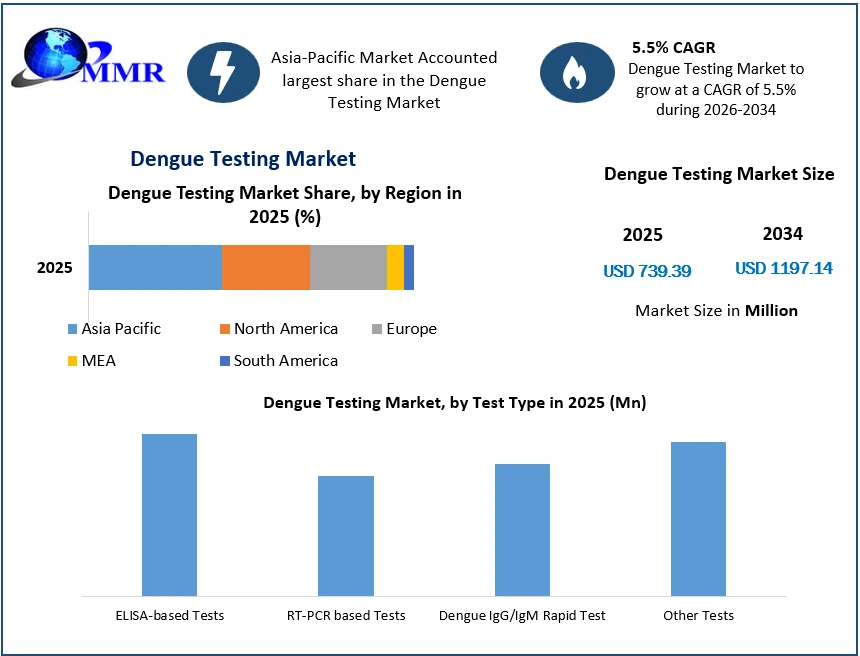
- The Dengue Testing Market is expected to reach USD 1197.14 million by 2034, expanding at a 5.5% CAGR.
- Rising dengue infections continue to increase demand for rapid and accurate diagnostic solutions.
- ELISA-based testing remains the largest market segment.
- RT-PCR testing is emerging as the fastest-growing technology due to higher diagnostic accuracy.
- Asia Pacific leads global demand owing to its high disease burden.
- Product innovation, regulatory approvals, and government procurement programs are reshaping market competition.
Why This Matters Now
Healthcare systems are facing mounting pressure as dengue outbreaks become more frequent across tropical and subtropical regions. Faster diagnosis is no longer simply a laboratory objective—it has become a frontline requirement for reducing mortality, preventing hospital overload, and limiting disease transmission.
For diagnostic manufacturers, hospital networks, investors, and public health agencies, the market is shifting toward technologies capable of delivering accurate results within minutes while supporting large-scale surveillance. Companies investing in molecular diagnostics, automated immunoassays, and decentralized testing platforms are strengthening their competitive position as governments expand infectious disease preparedness.
Market Overview
The Dengue Testing Market is projected to grow from USD 739.39 million in 2025 to USD 1,197.14 million by 2034, registering a 5.5% CAGR during the forecast period.
Dengue fever continues to affect millions of people every year across Africa, the Americas, Southeast Asia, the Eastern Mediterranean, and the Western Pacific. Approximately 500,000 cases progress to severe dengue annually, resulting in nearly 25,000 deaths worldwide. These figures continue to drive investment in earlier diagnosis, stronger laboratory infrastructure, and faster clinical decision-making.
Diagnostic technologies including ELISA, RT-PCR, and rapid antigen tests have become essential components of outbreak response. Healthcare providers increasingly require tests that combine speed, sensitivity, affordability, and scalability to improve patient outcomes while supporting national disease surveillance programs.
Climate change, rapid urbanization, international travel, and inadequate sanitation continue to expand mosquito habitats, increasing the long-term need for reliable dengue diagnostics.
Key Trends Driving Growth
Disease surveillance has become a strategic healthcare investment rather than a seasonal response. Governments are strengthening laboratory capacity and expanding community-level testing to identify outbreaks earlier and reduce hospitalization rates.
Healthcare providers are also adopting rapid point-of-care diagnostics that shorten clinical decision timelines. Faster diagnosis enables earlier supportive treatment, helping reduce complications associated with severe dengue while improving resource allocation during outbreaks.
Technology innovation is reshaping the competitive landscape. Manufacturers are introducing multiplex molecular assays, automated immunoassay platforms, and rapid serotyping solutions capable of identifying multiple dengue virus variants within minutes.
Artificial intelligence and digital laboratory workflows are gradually improving diagnostic efficiency. Automated interpretation, laboratory connectivity, and integrated reporting systems are expected to strengthen disease monitoring while supporting public health surveillance.
Growing research investments are encouraging the development of affordable testing platforms with higher specificity and sensitivity. Cost-effective diagnostics remain especially important across emerging economies where dengue prevalence continues to rise.
Download a Sample Report Featuring Key Market Drivers and Challenges
Segment Insights
- Dominant Segment: ELISA-based Tests
ELISA-based testing continues to account for the largest market share due to its established clinical reliability, quantitative analysis capability, shorter testing time, and broad adoption across hospitals and diagnostic laboratories. The technology represented approximately 63.7% of immunoassay revenue in 2025, supported by its effectiveness in detecting dengue IgM and IgG antibodies during routine diagnosis.
- Fastest-Growing Segment: RT-PCR Based Tests
RT-PCR diagnostics are expected to record the fastest growth throughout the forecast period. Their ability to detect viral genetic material during the earliest stages of infection significantly improves clinical accuracy and outbreak containment. Continued product innovation and licensing agreements are expanding commercial availability of advanced molecular testing platforms.
- End Users
Hospitals remain the largest end-user segment due to high patient volumes and integrated laboratory capabilities. Diagnostic centers continue expanding capacity as healthcare systems decentralize infectious disease testing to improve accessibility and reduce pressure on tertiary hospitals.
Regional Growth Story
Asia Pacific continues to dominate the Dengue Testing Market because of its exceptionally high disease burden and expanding healthcare infrastructure. India, China, Southeast Asia, and other regional markets continue investing in surveillance programs, laboratory modernization, and wider access to rapid diagnostics.
India has experienced a steady increase in dengue cases over recent years, reinforcing demand for scalable diagnostic technologies. Pakistan and Sri Lanka are also strengthening testing capacity as governments respond to recurring outbreaks.
North America represents a growing opportunity as expanding mosquito habitats increase awareness among healthcare providers and public health authorities. Updated clinical guidance is encouraging broader laboratory preparedness despite relatively lower disease prevalence.
Europe continues investing in infectious disease surveillance as international travel increases imported dengue cases. Advanced laboratory infrastructure supports adoption of molecular diagnostics across leading healthcare systems including Germany and the United Kingdom.
Latin America remains an important growth region, particularly Brazil, where government procurement programs are expanding nationwide diagnostic access through public healthcare networks.
Competitive Landscape
Competition is increasingly focused on diagnostic speed, automation, accuracy, and accessibility rather than simply expanding product portfolios.
Global diagnostic leaders including Thermo Fisher Scientific, Abbott Laboratories, Danaher Corporation, Roche, bioMérieux, QIAGEN, Siemens Healthineers, Sysmex Corporation, Seegene, SD Biosensor, Molbio Diagnostics, and Sansure Biotech continue investing in molecular diagnostics, automated immunoassays, and decentralized testing technologies.
Companies developing rapid point-of-care solutions are strengthening their market position by enabling testing beyond centralized laboratories. Strategic licensing agreements, regulatory approvals, and investments in multiplex diagnostics indicate that future competition will increasingly depend on integrated infectious disease testing platforms rather than standalone dengue assays.
Recent Developments
- October 2025: Roche received CE marking for its Elecsys Dengue Ag automated immunoassay, enabling high-throughput laboratory testing with an 18-minute turnaround time.
- January 2025: VisGene launched the VisCheck Dengue NS1 Rapid Antigen Serotyping Test following regulatory approval in Thailand, introducing rapid identification of all four dengue serotypes.
- February 2025: Brazil’s Ministry of Health initiated procurement of 6.5 million rapid dengue diagnostic tests to strengthen nationwide outbreak management.
- April 2025: The World Health Organization updated interim laboratory guidance recommending multiplex molecular assays alongside combination NS1 and IgM rapid testing.
- August 2025: The U.S. Centers for Disease Control issued revised clinical guidance recommending dual testing algorithms using NAAT together with NS1 or IgM testing.
Strategic Implications
Healthcare providers are shifting toward integrated diagnostic strategies that combine rapid screening with confirmatory molecular testing. This approach improves diagnostic confidence while supporting more efficient patient management.
Diagnostic manufacturers capable of delivering affordable, automated, and high-throughput testing solutions are likely to benefit from expanding government procurement programs and hospital modernization initiatives.
Regulatory alignment from organizations such as WHO and national public health agencies is also reducing uncertainty for manufacturers seeking wider commercialization of advanced dengue diagnostics.
For investors, infectious disease diagnostics continues to represent a resilient healthcare segment supported by recurring outbreaks, stronger surveillance infrastructure, and increasing government healthcare expenditure.
Future Outlook
The Dengue Testing Market is expected to maintain steady expansion as infectious disease surveillance becomes a permanent component of national healthcare strategies. Advances in molecular diagnostics, rapid antigen detection, digital laboratory integration, and decentralized testing will continue improving clinical outcomes while supporting faster outbreak containment. Organizations that combine innovation, affordability, regulatory readiness, and scalable manufacturing will define the next generation of dengue diagnostics, while slower adopters risk losing relevance in an increasingly technology-driven market.
Analyst Perspective
“The future of dengue diagnostics will be shaped by technologies that deliver earlier detection, faster turnaround times, and broader accessibility. As governments strengthen surveillance systems and healthcare providers prioritize timely diagnosis, innovation in molecular testing and rapid point-of-care solutions will become a decisive competitive advantage for market participants.” — Komal Patil, Analyst
About Maximize Market Research
Maximize Market Research Pvt. Ltd. (MMR) is a global market research and consulting company that provides reliable, data-focused, and practical business insights. The firm serves a wide range of industries, including healthcare, pharmaceuticals, technology, automotive, electronics, chemicals, personal care, and consumer goods. Through market forecasts, competitive analysis, strategic consulting, and industry impact assessments, MMR helps organizations understand changing market conditions, identify growth opportunities, and make informed business decisions for long-term success.
Contact Us
2nd Floor, Navale IT Park Phase 3
Pune Banglore Highway, Narhe
Pune, Maharashtra 411041, India
+91 9607365656
sales@maximizemarketresearch.com