Market Overview
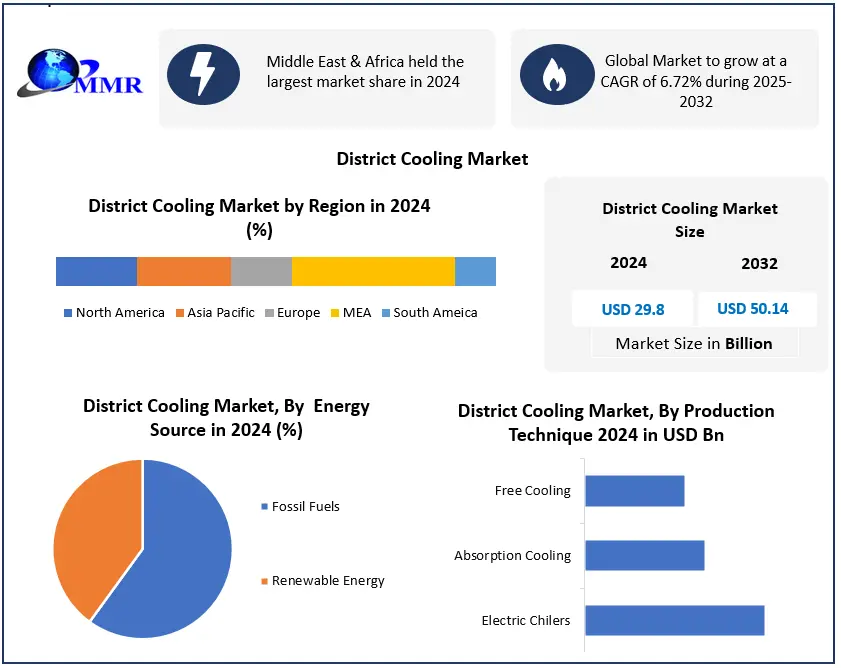
The global District Cooling Market is entering a new phase of infrastructure modernization. According to Maximize Market Research, the market was valued at USD 29.8 billion in 2024 and is expected to reach USD 50.14 billion by 2032, growing at a CAGR of 6.72% during the forecast period.
The significance extends beyond cooling capacity. District cooling networks increasingly operate as intelligent energy platforms capable of reducing electricity consumption, optimizing load management, and supporting sustainability objectives. This evolution is attracting attention from municipal planners, infrastructure investors, utility operators, and technology providers.
The emergence of smart cities is further accelerating deployment. Large urban developments are prioritizing centralized cooling systems as part of broader digital infrastructure strategies that combine energy efficiency, operational visibility, and long-term cost optimization.
Key Trends Driving Growth
Industry leaders are increasingly integrating digital technologies into cooling operations. Smart and AI-integrated systems are emerging as a distinct market category, reflecting demand for automated control, data-driven optimization, and intelligent energy management.
Industrial IoT adoption is becoming increasingly relevant across cooling networks. Connected sensors, real-time monitoring platforms, and centralized control systems enable operators to improve system efficiency while reducing operational costs.
Thermal storage technologies are also gaining attention. Chilled water storage and ice thermal storage solutions provide operators with greater flexibility in managing peak demand periods. This capability strengthens grid resilience while improving energy utilization.
The market is also witnessing greater integration of renewable energy sources. As governments pursue decarbonization targets, district cooling infrastructure is being positioned as a practical mechanism for reducing energy intensity across commercial and residential developments.
Another notable trend is the convergence of operational technology and digital analytics. AI-enabled optimization, predictive maintenance capabilities, and advanced control systems are helping operators improve asset utilization while reducing maintenance-related disruptions.
Request a Free Sample Copy or View Report Summary:https://www.maximizemarketresearch.com/request-sample/31909/
Segment Insights
- Dominant Segment: Commercial End User
- Commercial facilities remain a major demand center for district cooling deployment due to high and continuous cooling requirements across business districts, mixed-use developments, airports, hospitality assets, and large institutional facilities.
- Fastest-Growing Segment: Smart/AI-Integrated Systems
- The inclusion of Smart/AI-Integrated Systems as a dedicated next-generation integration category highlights increasing investment in intelligent infrastructure capable of automated optimization and data-driven performance management.
- Production Technique Segments:
- Free Cooling
- Absorption Cooling
- Electric Chillers
- Energy Source Segments:
- Fossil Fuels
- Renewable Energy
- Thermal Storage Segments:
- Chilled Water Storage
- Ice Thermal Storage
- No Storage
- End User Segments:
- Residential
- Commercial
- Industrial
Regional Growth Story
The District Cooling Market reflects differing regional priorities but a common focus on energy efficiency and urban scalability.
The Middle East continues to represent a strategic deployment environment due to large-scale urban developments and sustained cooling demand. Major infrastructure projects across Gulf economies are creating opportunities for advanced cooling networks integrated with broader smart city initiatives.
Asia-Pacific is emerging as a critical growth region as governments invest heavily in urban infrastructure modernization. Rapid urbanization, industrial expansion, and increasing focus on sustainable city planning are encouraging adoption of centralized cooling solutions.
China, India, Japan, and South Korea are expanding investments in digital infrastructure and energy-efficient urban development. These initiatives align closely with district cooling deployments that support both sustainability and long-term energy management objectives.
In Europe, decarbonization goals and energy transition policies continue to encourage interest in centralized cooling systems capable of supporting environmental targets.
North America is witnessing increasing interest in intelligent energy infrastructure, particularly in large commercial campuses, mixed-use developments, healthcare facilities, and institutional environments seeking operational efficiency improvements.
Competitive Landscape
Competition is increasingly defined by technology integration rather than cooling capacity alone.
Companies including Danfoss, Veolia, ENGIE, Emicool, Tabreed, Alfa Laval, Daikin Industries, SHINRYO CORPORATION, Ramboll Group, AtkinsRéalis, and Keppel are operating within an ecosystem that is becoming progressively digitalized.
The strategic signal is clear. Market leaders are positioning themselves around system intelligence, energy optimization, renewable integration, and infrastructure scalability.
Technology leadership increasingly depends on the ability to combine cooling infrastructure with digital monitoring, predictive analytics, AI-driven controls, and operational automation. This mirrors broader Industry 4.0 trends where infrastructure assets evolve into connected operational platforms.
Organizations capable of integrating intelligent controls with energy-efficient cooling architectures are likely to strengthen competitive positioning as customers prioritize lifecycle performance rather than standalone equipment selection.
Recent Developments
- Increased market focus on Smart/AI-Integrated Systems.
- Growing adoption of renewable energy-based cooling infrastructure.
- Expansion of thermal storage technologies to support peak-load management.
- Continued investment in large-scale urban and smart city developments.
- Greater emphasis on energy optimization and operational efficiency initiatives.
- Rising interest in digital monitoring and intelligent control platforms.
Strategic Implications
For infrastructure investors, district cooling is increasingly viewed as a long-duration asset class aligned with sustainability and urbanization megatrends.
For city planners, centralized cooling offers a pathway to reduce grid stress while supporting environmental objectives.
For technology providers, the opportunity extends beyond mechanical equipment. The value chain is expanding toward AI-powered optimization, predictive maintenance software, digital twins, industrial IoT platforms, cybersecurity frameworks, and intelligent energy management systems.
For industrial operators and commercial developers, district cooling represents an operational efficiency strategy capable of reducing lifecycle costs while supporting sustainability commitments.
Future Outlook
The next phase of market evolution will be defined by the convergence of cooling infrastructure and digital intelligence. AI-enabled optimization, connected assets, predictive maintenance, and renewable energy integration are expected to become increasingly important competitive differentiators.
As urban infrastructure becomes more data-driven, district cooling networks will evolve from utility assets into intelligent energy ecosystems. The organizations that digitize operations, automate optimization, and integrate smart infrastructure capabilities will define the next generation of market leadership, while those relying on conventional cooling models risk falling behind the Industry 4.0 transformation.
Analyst Perspective
“District cooling is evolving beyond energy efficiency into a digitally enabled infrastructure platform. The emergence of smart and AI-integrated systems indicates that future competitiveness will depend on how effectively operators combine cooling performance with automation, data intelligence, and sustainable energy management.”
— Neha Nalawade, Research Analyst
About Maximize Market Research
Maximize Market Research Pvt. Ltd. (MMR) is a global market research and consulting company that provides reliable, data-focused, and practical business insights. The firm serves a wide range of industries, including healthcare, pharmaceuticals, technology, automotive, electronics, chemicals, personal care, and consumer goods. Through market forecasts, competitive analysis, strategic consulting, and industry impact assessments, MMR helps organizations understand changing market conditions, identify growth opportunities, and make informed business decisions for long-term success.
2nd Floor, Navale IT Park Phase 3
Pune Banglore Highway, Narhe
Pune, Maharashtra 411041, India
+91 9607365656
sales@maximizemarketresearch.com