
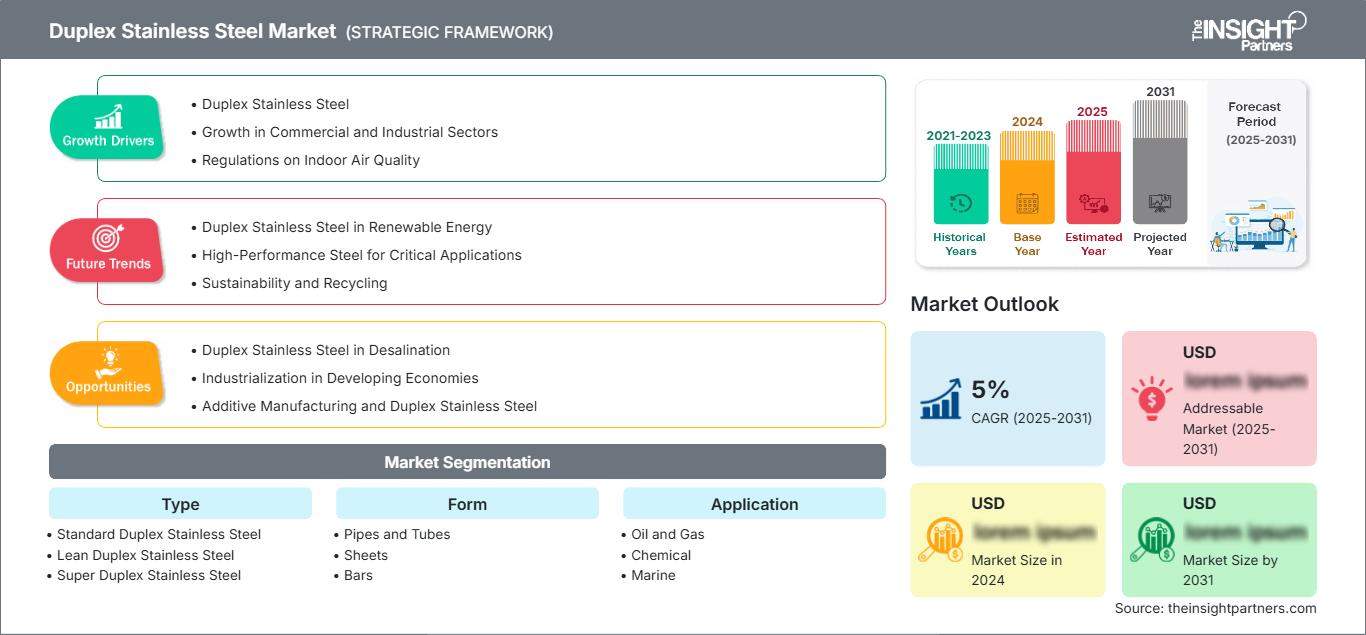
Corrosion is one of the costliest problems in heavy industry. It damages pipelines, shuts down plants, and drives up maintenance budgets. The Duplex Stainless-Steel Market is gaining ground as industries look for stronger, longer-lasting materials. The market size is expected to grow from US$ 5.59 Billion in 2025 to US$ 9.32 Billion by 2034, registering a CAGR of 5.84% during the forecast period 2026–2034. Growing demand from oil and gas, desalination, and chemical processing industries is driving this expansion.
What Is Duplex Stainless Steel?
Duplex stainless steel has a mixed microstructure of austenite and ferrite phases. This gives it roughly twice the strength of standard austenitic grades and significantly better resistance to stress corrosion cracking. Industries that operate in harsh, wet, or chemically aggressive environments value it for these properties.
Request a Sample Copy of the Report: https://www.theinsightpartners.com/sample/TIPRE00005083
What Is Driving the Duplex Stainless-Steel Market?
Oil and gas is the biggest end-use sector. Offshore platforms, subsea pipelines, and onshore processing facilities all face extreme conditions. Saltwater, hydrogen sulphide, and high pressures attack conventional steels quickly. Duplex grades resist these conditions far better and last longer. As energy companies push into deeper offshore fields and more corrosive environments, demand for duplex steel in tubes, valves, and fittings is rising steadily.
Desalination is another fast-growing driver. Water scarcity is a serious problem across the Middle East, North Africa, and parts of Asia. Governments are building large desalination plants to secure freshwater supply. These facilities pump seawater at high pressure through membranes and heat exchangers. The materials must resist chloride-induced corrosion continuously. Duplex stainless steel is the material of choice for pumps, piping, and pressure vessels in these plants.
The chemical processing industry adds substantial demand. Plants handling acids, chlorides, and other aggressive media need materials that do not corrode or contaminate the product stream. Duplex steel offers superior chemical resistance compared to carbon steel and is cost-competitive against nickel alloys in many applications. This balance of performance and price is a key reason chemical engineers specify it.
Construction is an emerging growth area. Duplex rebar and mesh are being used in coastal infrastructure projects, bridges, and marine structures where standard carbon steel would rust quickly. The higher upfront cost is offset by lower maintenance expense and longer service life. Several major infrastructure projects in the Middle East and Asia have already specified duplex rebar as the standard.
Paper and pulp manufacturing round out the major end-use segments. Digesters, bleaching equipment, and washing systems all handle corrosive process fluids at elevated temperatures. Duplex grades outperform standard stainless in these environments, reducing unplanned shutdowns and maintenance costs for mill operators.
Segmentation Overview
By Grade: Standard Duplex grades account for the largest share, used widely across oil and gas, chemical, and construction applications. Lean Duplex offers lower cost with adequate performance for less demanding uses such as structural applications and storage tanks. Super and Hyper Duplex grades serve the most severe environments, including deepwater oil and gas and aggressive chemical service.
By Product Form: Tubes are the dominant product form, driven by oil and gas and desalination demand. Pumps and valves follow closely. Fittings and flanges, welding wires, and rebar and mesh each serve distinct application needs across the end-use industries.
By End-Use Industry: Oil and gas leads by a clear margin. Desalination and chemical industries follow. Construction is the fastest-growing segment as infrastructure investment rises globally. Paper and pulp and other industries contribute steady baseline demand.
Key Market Players
- Outokumpu Oyj (Finland)
- Tata Steel (India)
- Jindal Steel (India)
- ArcelorMittal S.A. (Luxembourg)
- POSCO Group (South Korea)
- Acerinox S.A. (Spain)
- Sandvik Materials Technology AB (Sweden)
- Allegheny Technologies Incorporated (U.S.)
- Daido Steel Co., Ltd. (Japan)
- Carpenter Technology Corporation (U.S.)
Outokumpu and Sandvik are recognised leaders in duplex stainless-steel technology, with deep expertise in high-performance grades. ArcelorMittal and POSCO bring large-scale production capacity. Indian producers Tata Steel and Jindal Steel are expanding their duplex portfolios to serve fast-growing domestic and export markets.
Sustainability and Innovation Trends
Sustainability is reshaping procurement decisions in steel-intensive industries. Duplex stainless steel already offers a sustainability advantage because its longer service life means fewer replacements and less material waste over a project’s lifetime. Producers are reinforcing this message as customers seek to reduce their total lifecycle carbon footprint.
On the innovation side, manufacturers are developing new lean duplex compositions that reduce nickel content without sacrificing corrosion resistance. This lowers raw material cost and reduces exposure to nickel price volatility. Advanced welding consumables for duplex grades are also improving, making fabrication faster and more reliable for end-users with less specialised workshop capability.
Buy Premium Report: https://www.theinsightpartners.com/buy/TIPRE00005083
Regional Outlook
Asia Pacific is the largest and fastest-growing regional market. China and India are expanding their oil and gas, chemical, and infrastructure sectors at pace, generating strong demand for duplex stainless steel across multiple product forms. South Korea and Japan contribute through their shipbuilding and petrochemical industries. Europe is a mature but technically advanced market. Scandinavia, Germany, and the UK drive demand through offshore energy and chemical processing applications. North America shows steady growth, underpinned by Gulf of Mexico offshore activity and shale-related chemical investment. The Middle East is a key growth region, with massive desalination and petrochemical projects generating consistent duplex steel demand. South and Central America contribute through Brazil’s offshore oil sector and Chile’s mining industry.
Related Reports:
Wear Resistant Steel Plate Market
About The Insight Partners
The Insight Partners is among the leading market research and consulting firms in the world. We take pride in delivering exclusive reports along with sophisticated strategic and tactical insights into the industry. Reports are generated through a combination of primary and secondary research, solely aimed at giving our clientele a knowledge-based insight into the market and domain. This is done to assist clients in making wiser business decisions. A holistic perspective in every study undertaken forms an integral part of our research methodology and makes the report unique and reliable.
Contact Us:
If you have any queries about this report or if you would like further information, please contact us:
Phone: +1-646-491-9876
E-mail: sales@theinsightpartners.com
Also Available in: Korean | German | Japanese | French | Chinese | Italian | Spanish


