Key Highlights
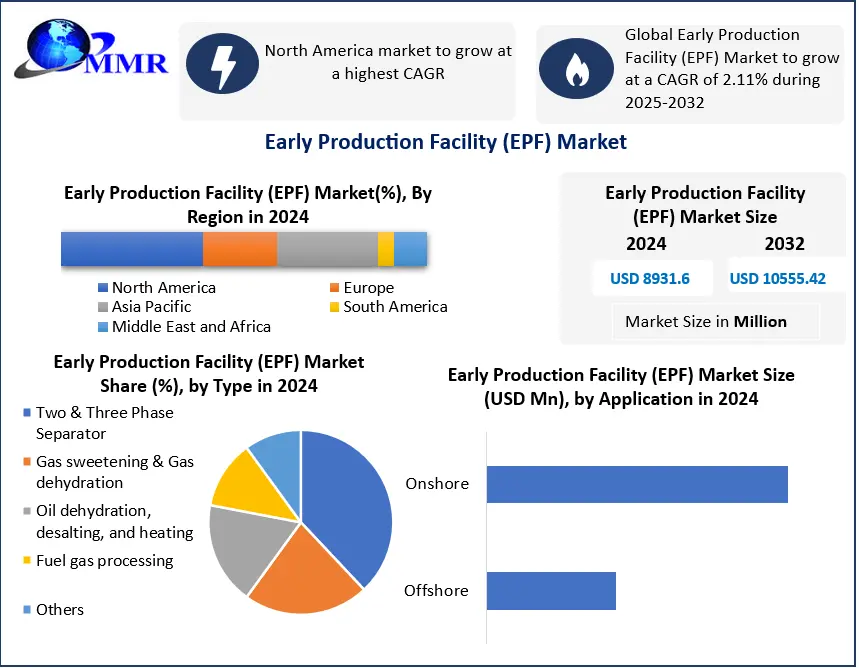
- Global Early Production Facility (EPF) Market was valued at USD 8,931.6 million in 2024.
- Market revenue is expected to reach nearly USD 10,555.42 million by 2032.
- The market is projected to expand at a CAGR of 2.11% from 2025 to 2032.
- Onshore applications accounted for 59% of market share in 2024.
- Two & Three Phase Separator systems represented the dominant equipment category.
- North America held 38.1% of the global market share.
- Rising investments in marginal fields and rapid monetization of discoveries are reshaping upstream project economics.
Why This Matters Now
Energy markets remain focused on two priorities: supply security and capital discipline. Oil and gas producers face pressure to monetize discoveries faster while limiting exposure to large, multi-year infrastructure investments. Early Production Facilities (EPFs) have emerged as a strategic answer to both challenges.
The shift is changing how upstream projects are developed. Instead of waiting years for permanent facilities, operators are increasingly deploying modular production systems that generate cash flow, collect reservoir data, and support development decisions early in a field’s lifecycle. The result is a shorter path from discovery to production and improved capital efficiency across exploration portfolios.
Market Overview
The Early Production Facility (EPF) Market is becoming a critical component of modern upstream energy development. EPFs are temporary or semi-permanent production systems deployed before full-scale production infrastructure is completed. Their primary value lies in accelerating first production, generating early revenue, and reducing development uncertainty.
The market was valued at USD 8,931.6 million in 2024 and is forecast to reach nearly USD 10,555.42 million by 2032. This expansion reflects growing demand for rapid monetization of new oil and gas discoveries and increasing investment in marginal field development. The business implication is clear: operators are prioritizing shorter payback periods and more flexible development strategies.
What changed is the industry’s approach to risk. EPFs are no longer viewed solely as temporary infrastructure. They are increasingly being integrated into long-term field development strategies because they provide operational flexibility and real-time production intelligence.
Get a sample of the report: https://www.maximizemarketresearch.com/request-sample/80505/
Key Trends Driving Growth
The strongest growth catalyst is the industry’s pursuit of faster asset monetization. In a volatile commodity environment, reducing the time between discovery and revenue generation creates a measurable competitive advantage. EPFs allow operators to begin production while permanent facilities are still under construction.
Another major trend is the development of marginal and mature fields. As conventional high-volume reservoirs become harder to access, operators are increasingly targeting assets that require lower-cost and more flexible production infrastructure. EPFs provide exactly that capability.
Shale production growth and unconventional resource development are also supporting deployment. The ability to rapidly assess reservoir performance through real-time production data improves investment decisions and optimizes future development plans. This data-driven approach aligns with broader digitalization trends across the energy sector.
The market is additionally benefiting from rising upstream capital expenditure in North America and Latin America, where new exploration and production projects continue to advance. Increased spending on production facilities signals confidence in long-term hydrocarbon demand despite broader energy transition initiatives.
Segment Insights
- Dominant Segment (Application): Onshore
- The onshore segment accounted for 59% of the market in 2024.
- Large numbers of mature onshore assets and ongoing exploration activity continue to support deployment.
- The segment benefits from lower installation complexity and faster project execution.
- Fastest-Growing Opportunity Segment: Offshore Development Support
- Growing investments in offshore projects are creating significant opportunities for EPF deployment.
- Approximately 600 new offshore oil and gas projects are expected to become operational by 2030, increasing demand for rapid production infrastructure.
- Dominant Segment (Type): Two & Three Phase Separator
- This segment led the market in 2024.
- Separators remain the core processing technology in EPFs because they perform the critical initial separation of oil, gas, and water streams.
- Demand is rising alongside new marginal field development projects across major producing regions.
Regional Growth Story
North America accounted for 38.1% of global market share, making it the leading regional market. The region’s strength stems from sustained investment in shale resources, upstream infrastructure, and exploration activities. Rising demand for crude oil and natural gas continues to support field development activity.
The United States remains particularly important because of its extensive shale production ecosystem. EPFs support rapid deployment strategies that align with the shorter development cycles common in unconventional resource projects.
Across Asia-Pacific, countries including India are expected to remain important opportunity markets due to growing energy demand and the need to expand domestic production capabilities. Meanwhile, mature fields across parts of Europe continue to create demand for flexible production solutions capable of extending asset life and maximizing recovery.
The Middle East and Africa also represent strategic growth territories as operators pursue cost-effective development of both new discoveries and aging reservoirs. EPFs help bridge the gap between exploration success and large-scale production infrastructure deployment.
Competitive Landscape
Competition is increasingly centered on deployment speed, modular engineering expertise, operational reliability, and lifecycle cost optimization.
Key participants include Weatherford International, Halliburton, Frames Group, Expro Group, TETRA Technologies, Petrocil, Process Group Pty. Ltd., and Global Process Systems.
The competitive signal is significant. Market leaders are positioning themselves around integrated production solutions rather than standalone equipment sales. This reflects a broader shift toward turnkey project execution, where operators seek reduced development timelines and simplified project management.
As upstream companies pursue capital efficiency, suppliers capable of delivering modular, scalable, and rapidly deployable facilities are likely to gain share. Technology leadership increasingly depends on operational flexibility and production optimization capabilities rather than equipment scale alone.
Recent Developments
- Increasing investment in marginal field development is supporting new EPF deployments.
- Growing upstream spending in the United States and Latin America is expanding project pipelines.
- Rising offshore project activity is creating additional demand for temporary production infrastructure.
- Operators are using EPFs to collect real-time reservoir performance data and improve long-term field development planning.
- Mature field optimization strategies are increasing demand for flexible production systems capable of extracting remaining reserves economically.
Strategic Implications
For operators, EPFs are becoming a strategic financial tool rather than merely a technical solution. Faster production startup improves project economics, reduces exposure to commodity price cycles, and accelerates cash generation.
For investors, EPF deployment often signals a disciplined capital allocation strategy. Companies that shorten development timelines can improve returns while maintaining operational flexibility.
For policymakers focused on energy security, EPFs support domestic production growth by enabling faster commercialization of discovered resources. In an era of geopolitical uncertainty, reducing development delays has become an increasingly important energy strategy.
Future Outlook
The next phase of market evolution will be defined by speed, flexibility, and data-driven field development. Operators will continue seeking production systems that reduce risk while maximizing early revenue generation.
As global energy demand remains resilient and producers focus on capital efficiency, EPFs will play an increasingly central role in upstream project execution. The companies that combine rapid deployment, reservoir intelligence, and scalable production solutions will define the next generation of field development, while slower-moving competitors risk losing access to the industry’s most attractive projects.
Analyst Perspective
“The Early Production Facility market is evolving from a temporary production solution into a strategic development platform. Operators are increasingly leveraging EPFs to accelerate commercialization, improve field economics, and generate critical production intelligence that shapes long-term asset performance.” — Neha Nalawade, Analyst
About Maximize Market Research
Maximize Market Research Pvt. Ltd. (MMR) is a global market research and consulting company that provides reliable, data-focused, and practical business insights. The firm serves a wide range of industries, including healthcare, pharmaceuticals, technology, automotive, electronics, chemicals, personal care, and consumer goods. Through market forecasts, competitive analysis, strategic consulting, and industry impact assessments, MMR helps organizations understand changing market conditions, identify growth opportunities, and make informed business decisions for long-term success.
Contact Maximize Market Research:
2nd Floor, Navale IT Park Phase 3
Pune Banglore Highway, Narhe
Pune, Maharashtra 411041, India
+91 9607365656
sales@maximizemarketresearch.com