Key Highlights
-
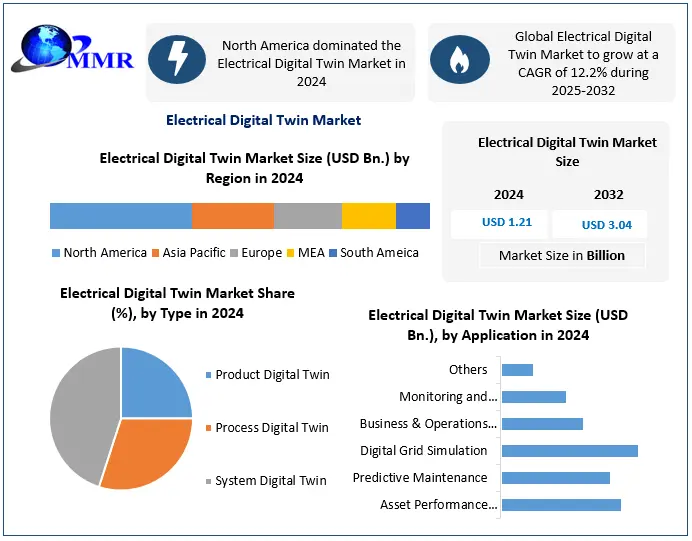
Global Electrical Digital Twin Market was valued at USD 1.21 Bn in 2024 and is expected to reach nearly USD 3.04 Bn by 2032 at a CAGR of 12.2%, showing that digital replicas of electrical networks are moving into mainstream grid and infrastructure planning.
-
Fast charging and EV adoption are highlighted as major demand drivers, signaling that power quality and peak load management are now critical digital twin use cases for utilities and urban planners.
-
Electrical digital twins are increasingly applied across generation, transmission, distribution, and end‑use infrastructure to simulate scenarios, reduce outages, and optimize capex.
-
The market’s growth trajectory indicates rising demand for AI‑enabled analytics, cloud deployment, and integration with existing SCADA, EMS, and asset management systems.
-
Vendors that combine electrical engineering depth with software, analytics, and integration capabilities are best placed as long‑term strategic partners to utilities, data center operators, and telecom providers.
Why This Matters Now
AI workloads, cloud regions, hyperscale data centers, and 5G networks are driving unprecedented electrical load and volatility. At the same time, EV fast charging is adding sharp, localized peaks that existing distribution networks were not designed to handle. A market rising from USD 1.21 Bn in 2024 to nearly USD 3.04 Bn by 2032 at 12.2% CAGR signals that digital twins of electrical systems are becoming essential to keep digital infrastructure powered reliably and affordably.
For CIOs, CTOs, energy managers, and telecom executives, electrical risk is now a core digital risk. Without accurate, continuously updated models of how networks behave under stress—from EV chargers to AI clusters—organizations cannot make confident decisions about where to build, how to connect, or how aggressively to electrify.
Market Overview
The Global Electrical Digital Twin Market around software models that mirror the behavior and state of real‑world electrical assets and networks in real time or near real time. These twins ingest operational data, asset parameters, and topology to simulate power flows, faults, and response under different scenarios. With 2024 revenue at USD 1.21 Bn and projected growth to nearly USD 3.04 Bn by 2032 at 12.2% CAGR, the market is moving from pilot projects to enterprise platforms.
Electrical digital twins span generation plants, transmission lines, substations, distribution feeders, and increasingly, end‑user infrastructure such as EV charging networks, industrial sites, data centers, and telecom power systems. They allow engineers and planners to test “what if” conditions—new loads, DER integration, outages—before physical changes, reducing risk and accelerating permitting and investment decisions.
In the Information Technology & Telecommunications sector, electrical digital twins help operators understand how power disturbances might affect data centers, base stations, and edge sites. They support decisions on redundancy, on‑site generation, battery placement, and dynamic load management—critical for uptime in a world where connectivity and compute are non‑negotiable.
Key Trends Driving Growth
The first major trend is the surge in fast charging and EV adoption. High‑power DC chargers create large, transient loads on local distribution networks and even on commercial and campus grids. Electrical digital twins give utilities, cities, and fleet operators a way to plan where to place chargers, how to reinforce feeders, and when to deploy storage or control schemes to avoid voltage drops and transformer stress.
Second, grid modernization and distributed energy are reshaping traditional power flows. Solar, wind, storage, and demand response are turning previously one‑way systems into complex, bidirectional networks. Digital twins can model these dynamics, helping utilities manage congestion, optimize voltage, and design new tariffs and connection policies that keep systems stable while enabling decarbonization.
Third, digital transformation of utilities and large energy users is accelerating. Advanced metering, IoT sensors, and connected assets provide the raw data that digital twins need. As organizations move SCADA, EMS, and planning tools onto modern, often cloud‑based platforms, it becomes feasible to integrate digital twins directly into daily operations, outage management, and predictive maintenance workflows.
Fourth, resilience and regulatory pressure are rising. Blackouts, extreme weather, and grid‑edge disturbances can bring down data centers and telecom networks. Regulators increasingly ask operators and utilities to demonstrate contingency planning and system strength. Digital twins help quantify impacts, test mitigation options, and justify investments, turning compliance from a static report into a continuously updated model.
Request a Free Sample Copy or View Report Summary: https://www.maximizemarketresearch.com/request-sample/32904/
Segment Insights
-
Dominant Segment
-
The Maximize Market Research report identifies a dominant segment—whether by application (generation, transmission, distribution), end‑user (utilities, industrials, infrastructure), or twin type—as capturing the largest share of Electrical Digital Twin Market revenue.
-
This segment indicates where digital twin technology has moved furthest beyond proof‑of‑concept into operational use, often supported by mature software offerings and integration with existing planning and control systems.
-
-
Fastest-Growing Segment
-
The fastest‑growing segment—potentially EV infrastructure, distribution networks, or industrial and campus grids—marks where new load patterns and electrification are creating urgent modeling needs.
-
Vendors that tailor their platforms, data connectors, and analytics to this segment will capture a disproportionate share of the additional USD 1.8+ Bn expected between 2025 and 2032.
-
-
By Application and End User
-
Utilities use electrical digital twins to simulate network expansion, evaluate DER integration, and optimize protection settings and switching schemes.
-
Large energy consumers—data centers, semiconductor fabs, industrial plants, telecom networks—use digital twins of their internal power systems to manage reliability, coordinate on‑site generation and storage, and support expansion without over‑engineering.
-
-
By Technology and Deployment
-
Solutions range from asset‑level twins of equipment (transformers, breakers, inverters) to full network twins including protection logic and automation schemes.
-
Deployment increasingly leverages cloud and hybrid models, enabling collaboration between utilities, consultants, and technology vendors and reducing time to update models with live data.
-
Regional Growth Story
MMR’s analysis sits within a global context in which the United States, Europe, and Asia‑Pacific are all modernizing their grids while electrifying transport and industry. In the US, digital twin adoption is propelled by aging infrastructure, EV incentives, data center expansion, and state‑level reliability and resilience mandates. Utilities and hyperscale operators are under pressure to justify major grid investments with data‑backed scenarios.
China and India are pushing massive grid expansion and EV rollouts simultaneously. Electrical digital twins help planners in these markets balance rapid growth, high renewable penetration, and urban load density, especially as cities host both EV fleets and cloud regions. For India in particular, digital twins can support the integration of renewable corridors with rapidly growing telecom and IT corridors.
Germany, the UK, Japan, and South Korea are all advanced technology and telecom markets with high reliability expectations. Their grids face the dual challenge of high renewable penetration and dense urban load, making digital twins attractive for distribution network management, substation automation planning, and ensuring stable supply to critical infrastructure like data centers and 5G networks.
Competitive Landscape
The Electrical Digital Twin Market brings together traditional power equipment manufacturers, industrial software leaders, and cloud/platform providers. Established electrical OEMs extend their portfolios with software that models their installed base and adjacent networks, turning product expertise into ongoing analytics and services revenue.
Industrial and engineering software vendors offer comprehensive digital twin platforms that integrate modeling, simulation, asset management, and operations. Their strength lies in supporting end‑to‑end workflows—from design through commissioning to real‑time operations—across multiple vendors’ equipment, which appeals to utilities and large enterprises with heterogenous fleets.
Cloud and IT players position digital twin capabilities as part of broader data and AI platforms. By hosting models, time‑series data, and analytics in scalable environments, they aim to become the default place where utilities and infrastructure operators build and run digital twins, which has long‑term implications for data gravity, partner ecosystems, and pricing power in energy‑adjacent digital services.
Recent Developments
-
Expansion of electrical digital twin use cases from planning and offline studies into real‑time or near‑real‑time operational support.
-
Increasing alignment of digital twin roadmaps with EV fast‑charging deployment, enabling utilities and cities to model and prioritize network reinforcements.
-
Integration of digital twins with broader “Energy 4.0” initiatives, combining IoT data, analytics, and automation for network‑level optimization.
-
Growing interest in cloud‑based and SaaS delivery models that lower entry barriers for mid‑size utilities, industrials, and campus operators.
Strategic Implications
For CIOs and CTOs in utilities, digital twins are becoming a central pillar of grid modernization. They bridge historically siloed planning, operations, and asset management systems, allowing teams to collaborate on shared, validated models rather than static one‑off studies. This change accelerates decision‑making and improves the quality of regulatory filings and investment cases.
For data center and telecom executives, electrical digital twins are a way to quantify and reduce power‑related risk. Modeling internal networks and points of interconnection helps teams test expansion plans, evaluate different redundancy strategies, and coordinate with utilities on grid upgrades, improving both resilience and negotiation leverage.
Investors and policymakers can treat digital twin adoption as a proxy for system intelligence. Regions and operators that invest in digital modeling and simulation are better positioned to integrate renewables, EVs, and new digital loads without compromising reliability—an increasingly important differentiator in attracting industrial and cloud investments.
Future Outlook
By 2032, as the Global Electrical Digital Twin Market approaches nearly USD 3.04 Bn on a 12.2% CAGR path, digital replicas of power systems will move from specialist tools to standard infrastructure for electrified, digital economies. Utilities, cities, and large energy users that do not have well‑maintained electrical twins will struggle to justify investments and manage risk in a world of volatile loads and distributed generation.
The decisive divide will be between digital leaders that fuse electrical digital twins with AI, cloud platforms, and real‑time operations—and laggards that rely on static studies and fragmented tools; the former will safely accelerate EV, data center, and 5G growth, while the latter face mounting outages, stranded assets, and lost competitiveness as electrification becomes the backbone of digital infrastructure.
Related Reports
Global Audio and Video Editing Software Market https://www.maximizemarketresearch.com/market-report/global-audio-video-editing-software-market/81897/
Speech To Speech Translation Market https://www.maximizemarketresearch.com/market-report/speech-to-speech-translation-market/188460/
Global AI in Fashion Market https://www.maximizemarketresearch.com/market-report/global-ai-in-fashion-market/54494/
Analyst Perspective
“Fast charging and EV adoption are forcing every stakeholder to rethink how electrical networks are planned and operated,” “Electrical digital twins give utilities, data centers, and telecom providers the ability to simulate the future grid before they build it—and those that invest early will move faster and with more confidence than their peers.”-Yash Ghosalkar
About Maximize Market Research
Maximize Market Research Pvt. Ltd. (MMR) is a global market research and consulting company that provides reliable, data-focused, and practical business insights. The firm serves a wide range of industries, including healthcare, pharmaceuticals, technology, automotive, electronics, chemicals, personal care, and consumer goods. Through market forecasts, competitive analysis, strategic consulting, and industry impact assessments, MMR helps organizations understand changing market conditions, identify growth opportunities, and make informed business decisions for long-term success.
2nd Floor, Navale IT Park Phase 3
Pune Banglore Highway, Narhe
Pune, Maharashtra 411041, India
+91 9607365656
sales@maximizemarketresearch.com