
Fleet Management Market Enters a New Growth Cycle as Software, Connectivity, and Electrification Redefine Transportation
Transportation companies are facing a strategic reality: operational efficiency is no longer determined by vehicle ownership alone. Data, connectivity, automation, and real-time fleet intelligence are becoming the primary drivers of competitiveness across logistics, mobility, and commercial transportation.
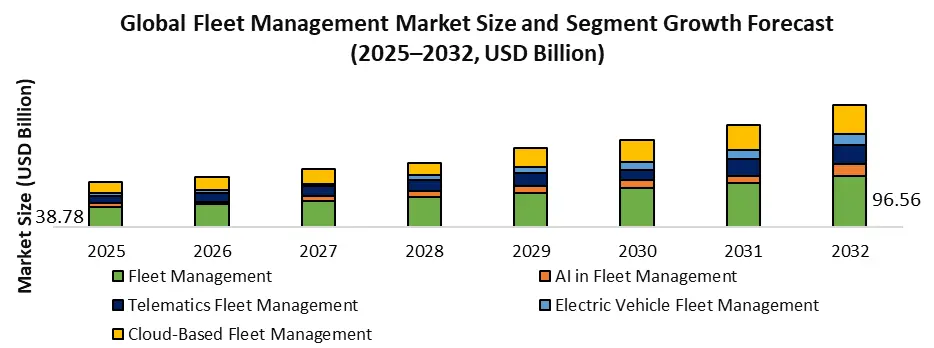
The Global Fleet Management Market was valued at USD 38.78 billion in 2025 and is projected to reach USD 96.56 billion by 2032, registering a CAGR of 13.92% during the forecast period. That growth signals a major shift in how fleets are managed, optimized, monitored, and monetized across global transportation networks. For fleet operators, OEMs, mobility providers, and technology suppliers, the market is evolving from a vehicle-management function into a digital business platform.
Key Highlights
- Global Fleet Management Market valued at USD 38.78 billion in 2025
- Market projected to reach USD 96.56 billion by 2032
- CAGR of 13.92% forecast through 2032
- Connected vehicle ecosystems accelerating fleet digitization
- Fleet operators increasingly adopting data-driven optimization strategies
- Real-time telematics and analytics becoming core operational tools
- Electrification trends creating new fleet management requirements
- Software-centric transportation models gaining strategic importance
Why This Matters Now
Fleet operators are operating in an environment defined by fuel volatility, rising compliance requirements, labor shortages, sustainability targets, and growing customer expectations for visibility. Traditional fleet oversight methods are struggling to keep pace with these pressures.
The response has been rapid adoption of connected technologies that provide real-time operational intelligence. Fleet management platforms are increasingly becoming mission-critical systems capable of improving asset utilization, reducing downtime, enhancing safety, and supporting regulatory compliance.
At the same time, the transportation sector is undergoing a broader transformation toward electrification and connected mobility. This transition is expanding the role of fleet management from operational monitoring to strategic business optimization.
Market Overview
The fleet management industry has moved well beyond vehicle tracking. Modern solutions integrate telematics, predictive maintenance, route optimization, fuel management, driver behavior monitoring, compliance management, and enterprise analytics into a single operational framework.
The projected increase from USD 38.78 billion in 2025 to USD 96.56 billion by 2032 indicates that transportation organizations are investing heavily in digital infrastructure to improve efficiency and resilience. Every percentage point improvement in fleet utilization can translate into substantial cost savings, making technology adoption increasingly attractive.
As transportation networks become more complex, fleet management platforms are emerging as central operating systems that connect vehicles, drivers, dispatchers, maintenance teams, and business decision-makers.
Key Trends Driving Growth
The expansion of connected vehicle ecosystems is creating unprecedented amounts of operational data. Fleet operators are increasingly leveraging this information to improve route planning, reduce idle time, optimize maintenance schedules, and enhance overall fleet performance.
Artificial intelligence and advanced analytics are transforming decision-making processes. Predictive maintenance capabilities help reduce unexpected vehicle failures, while intelligent routing systems improve delivery efficiency and lower operating costs.
Electrification is creating another major growth catalyst. As commercial fleets incorporate electric vehicles, operators require new tools to monitor battery performance, charging schedules, energy consumption, and vehicle range. Fleet management platforms are evolving to address these emerging requirements.
Software-defined vehicle development is also influencing market dynamics. Connected vehicles capable of transmitting continuous operational data create new opportunities for fleet visibility, diagnostics, and over-the-air service management.
Sustainability initiatives are further accelerating adoption. Organizations seeking to reduce emissions and meet environmental targets increasingly rely on fleet management technologies to monitor fuel consumption, optimize routes, and improve operational efficiency.
Get more information:https://www.maximizemarketresearch.com/request-sample/29184/
Segment Insights
- Dominant Segment: Information on the dominant segment was not specified in the source report.
- Fastest-Growing Segment: Information on the fastest-growing segment was not specified in the source report.
- Telematics-enabled fleet operations continue to gain strategic importance across commercial transportation.
- Cloud-based fleet management platforms are supporting scalable deployment across geographically dispersed operations.
- Analytics-driven fleet optimization solutions are becoming increasingly valuable for logistics-intensive industries.
- Connected vehicle integration is expanding the scope of fleet intelligence capabilities.
Regional Growth Story
The fleet management market’s growth reflects broader transportation modernization initiatives across major automotive and logistics regions.
The United States continues to benefit from advanced telematics adoption, growing e-commerce logistics requirements, and increasing demand for connected transportation infrastructure. Fleet operators are investing in technologies that improve operational visibility and support large-scale logistics networks.
Europe’s market development is strongly influenced by sustainability objectives and regulatory frameworks focused on emissions reduction. Fleet management technologies play a critical role in helping operators meet environmental targets while maintaining operational efficiency.
China remains a significant force in transportation digitization, supported by large-scale logistics operations, connected vehicle deployment, and smart mobility investments. The country’s rapid technology adoption is contributing to broader market expansion.
India is emerging as an important growth market as logistics modernization, digital transformation, and commercial vehicle connectivity initiatives gain momentum. Rising demand for transportation efficiency is encouraging adoption across multiple industry sectors.
Japan and South Korea continue to leverage their advanced automotive ecosystems to support innovation in connected vehicle technologies, fleet analytics, and mobility solutions.
Competitive Landscape
Competition in the fleet management market is increasingly centered on software capabilities rather than hardware differentiation alone. Market leaders are positioning themselves around integrated ecosystems that combine telematics, analytics, connectivity, compliance management, and operational intelligence.
The strategic direction of the industry suggests a growing convergence between automotive technology, enterprise software, and mobility services. Companies that can deliver comprehensive platforms are likely to gain advantages in customer retention and recurring revenue generation.
OEMs are becoming more active participants in fleet technology ecosystems as connected vehicle capabilities expand. This trend signals a shift from vehicle-centric value creation toward lifecycle-based service models that generate ongoing revenue streams.
Technology providers are focusing on artificial intelligence, predictive analytics, and cloud-based architecture to strengthen competitive positioning. The emphasis on software innovation highlights the increasing importance of digital capabilities in transportation management.
Supplier dynamics are also evolving. Traditional hardware-focused offerings are being complemented by data services, analytics solutions, and subscription-based business models, creating new sources of value creation.
Recent Developments
- Growing integration of telematics and analytics into commercial fleet operations
- Expansion of connected vehicle technologies across transportation networks
- Increased investment in cloud-based fleet management platforms
- Rising focus on fleet electrification support capabilities
- Greater adoption of predictive maintenance and AI-driven optimization tools
- Continued evolution of mobility and transportation digitization strategies
Strategic Implications
For fleet operators, investment priorities are shifting toward technologies that generate measurable operational improvements. Real-time visibility, predictive maintenance, and route optimization are becoming competitive necessities rather than optional enhancements.
OEMs have an opportunity to strengthen customer relationships through integrated fleet services. Connected vehicle platforms can create recurring revenue streams while improving customer retention throughout the vehicle lifecycle.
Technology providers face significant opportunities in software development, analytics, artificial intelligence, and data management. As fleets generate larger volumes of operational information, the ability to convert data into actionable insights will become a key differentiator.
Investors are increasingly viewing fleet management as a critical component of transportation digitization. The sector’s growth trajectory reflects broader demand for intelligent mobility infrastructure and data-driven operational models.
Future Outlook
The next phase of fleet management will be defined by deeper integration between connected vehicles, artificial intelligence, electrification, and mobility platforms. Fleet operators will increasingly rely on software ecosystems that provide end-to-end visibility across transportation operations.
As vehicle connectivity expands and transportation networks become more digital, the competitive landscape will favor organizations capable of transforming operational data into strategic advantage. The companies that build intelligent, software-centric fleet ecosystems will define the future of transportation, while those that remain dependent on traditional fleet management models risk losing relevance in a data-driven mobility economy.
Analyst Perspective
“The fleet management industry is entering a period where connectivity, operational intelligence, and digital transformation are becoming central to transportation competitiveness. Organizations that leverage advanced fleet technologies will be better positioned to improve efficiency, support sustainability objectives, and adapt to evolving mobility requirements,” says Tejaswini Kakade, Analyst.
About Maximize Market Research
Maximize Market Research Pvt. Ltd. (MMR) is a global market research and consulting company that provides reliable, data-focused, and practical business insights. The firm serves a wide range of industries, including healthcare, pharmaceuticals, technology, automotive, electronics, chemicals, personal care, and consumer goods. Through market forecasts, competitive analysis, strategic consulting, and industry impact assessments, MMR helps organizations understand changing market conditions, identify growth opportunities, and make informed business decisions for long-term success.
Contact Us:
2nd Floor, Navale IT Park Phase 3
Pune Banglore Highway, Narhe
Pune, Maharashtra 411041, India
+91 9607365656
sales@maximizemarketresearch.com

