The global graph database is experiencing remarkable growth as enterprises increasingly rely on connected data to gain deeper business insights and improve operational efficiency. Traditional relational databases are often limited when processing highly interconnected datasets, whereas graph databases are specifically designed to identify relationships between entities quickly and efficiently.
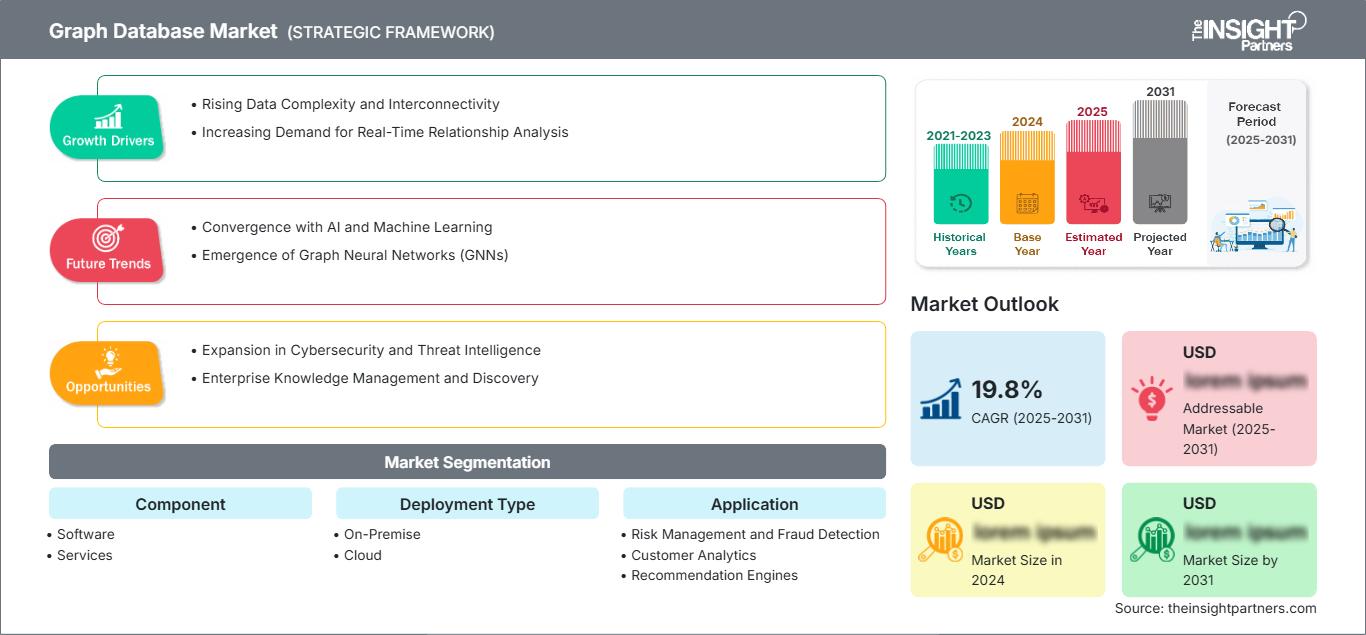
According to The Insight Partners, The global Graph Database Market size is projected to reach US$ 16.34 billion by 2034 from US$ 4.22 billion in 2025. The market is anticipated to register a CAGR of 18.42% during the forecast period 2026-2034.
Market Overview
The Graph databases store information using nodes, edges, and properties instead of traditional tables and rows. This architecture enables organizations to understand complex relationships between data points more effectively. Businesses handling large volumes of interconnected information across finance, healthcare, telecommunications, retail, logistics, and cybersecurity are increasingly adopting graph databases to improve performance and accelerate decision-making.
The rapid growth of digital transformation initiatives, cloud computing, IoT devices, and AI-powered applications has significantly increased the amount of connected data generated worldwide. Organizations require database technologies capable of handling these evolving data structures while maintaining high-speed query performance and scalability.
Key Market Drivers
- Rising Data Complexity:-Organizations generate enormous amounts of structured and unstructured information from multiple digital channels. Social media interactions, customer transactions, IoT devices, enterprise applications, and digital ecosystems create highly interconnected datasets that traditional databases struggle to process efficiently.
- Increasing Adoption of Artificial Intelligence:-Artificial intelligence applications depend heavily on high-quality connected data. Knowledge graphs provide AI models with contextual relationships that improve recommendation systems, semantic search, conversational AI, fraud detection, and predictive analytics.
- Growing Demand for Real-Time Analytics:-Businesses require instant insights from rapidly changing datasets. Financial institutions need real-time fraud detection, retailers require personalized recommendations, while logistics providers monitor supply chain networks continuously.
- Expansion of Cloud Computing:-Cloud deployment has accelerated graph database adoption by reducing infrastructure costs and enabling scalable database management. Cloud-native graph platforms provide flexibility, automatic scaling, high availability, and simplified maintenance, making them attractive for enterprises of all sizes.
Get Sample PDF of the report @ https://www.theinsightpartners.com/sample/TIPRE00006565
Emerging Market Trends
- Integration with Graph Neural Networks:-Graph Neural Networks (GNNs) are emerging as one of the most important AI technologies for processing graph-structured data. Their increasing adoption is creating additional demand for graph databases capable of storing and managing highly connected datasets.
- Growth of Knowledge Graphs:-Knowledge graphs are becoming central to enterprise search, digital assistants, and business intelligence platforms. Companies use knowledge graphs to integrate data from multiple sources while improving search relevance and contextual understanding.
- Hybrid AI Architectures:-Organizations increasingly combine graph databases with vector databases, machine learning models, and large language models (LLMs) to improve AI accuracy and reduce hallucinations in enterprise AI systems.
- Multi-Cloud Deployments:-Businesses are deploying graph databases across hybrid and multi-cloud environments to improve resilience, regulatory compliance, and operational flexibility.
Market Opportunities
Several high-growth opportunities are expected to shape future market expansion.
Cybersecurity remains one of the strongest application areas. Graph databases enable organizations to visualize attack paths, identify suspicious network behaviour, detect fraud, and perform threat intelligence analysis more efficiently.
Enterprise knowledge management also presents significant opportunities. Organizations are building connected repositories that improve collaboration, document discovery, regulatory compliance, and organizational learning.
Healthcare organizations increasingly use graph databases for drug discovery, genomics research, patient relationship mapping, and clinical decision support systems.
Financial institutions continue expanding graph database usage for anti-money laundering (AML), fraud detection, customer risk assessment, and compliance monitoring.
Get the Premium Research Report @ https://www.theinsightpartners.com/buy/TIPRE00006565
Market Segmentation
By Component
- Software
- Services
Software solutions account for the largest market share due to increasing demand for scalable graph database platforms, while consulting, implementation, and managed services continue to support enterprise deployments.
By Deployment
- Cloud
- On-Premise
Cloud deployment is expected to experience the fastest growth because of its scalability, lower operational costs, and simplified infrastructure management.
By Application
Major application areas include:
- Risk Management and Fraud Detection
- Customer Analytics
- Recommendation Engines
- Supply Chain Management
- Operations and Asset Management
- Knowledge Management
- Scientific Data Management
- Other Applications
Fraud detection and customer analytics remain among the fastest-growing application segments due to increasing digital transactions and personalized customer engagement initiatives.
By Type
The Graph Database Market includes:
- Property Graph
- Resource Description Framework (RDF)
Property graph databases dominate commercial deployments because of their flexibility and developer-friendly architecture, while RDF databases remain popular for semantic web and knowledge graph applications.
By Industry Vertical
Graph databases are widely adopted across:
- BFSI
- Healthcare
- Telecom and IT
- Retail and E-commerce
- Transportation and Logistics
- Government
- Media and Entertainment
- Travel and Hospitality
- Manufacturing
- Other Industries
Regional Analysis
North America
North America currently leads the graph database market due to strong technology infrastructure, widespread AI adoption, and significant investments by cloud service providers and enterprise software vendors.
The United States continues to dominate regional growth as organizations accelerate digital transformation and cybersecurity initiatives.
Europe
European organizations increasingly adopt graph databases for financial compliance, manufacturing automation, healthcare analytics, and government digitalization programmes. Strong data governance regulations also encourage investments in advanced data management platforms.
Asia-Pacific
Asia-Pacific is expected to witness the fastest market growth during the forecast period. Countries including China, India, Japan, South Korea, and Australia continue expanding investments in AI, cloud computing, smart cities, fintech, and e-commerce, creating significant opportunities for graph database vendors.
Middle East & Africa and South America
Digital transformation initiatives, government modernization projects, and increasing enterprise cloud adoption are gradually supporting graph database deployment across emerging economies.
Competitive Landscape
The graph database market remains highly competitive, with both established technology companies and specialized database vendors investing in innovation. Companies continue enhancing AI integration, cloud-native capabilities, graph analytics, security, and developer tools to strengthen their competitive positions.
Major companies operating in the market include:
- Amazon Web Services, Inc.
- Callidus Software Inc.
- IBM Corporation
- Microsoft Corporation
- arkLogic Corporation
- Neo4j, Inc.
- Oracle Corporation
- OpenLink Software
- Teradata Corporation
- TIBCO software Inc.
Strategic partnerships, acquisitions, cloud platform expansion, and AI-focused product development remain common growth strategies among leading vendors.
Future Outlook
The future of the graph database market appears exceptionally promising as organizations increasingly recognize the value of connected data. The rapid growth of artificial intelligence, machine learning, digital twins, cybersecurity, recommendation systems, and enterprise knowledge graphs will continue driving demand for advanced graph database technologies.
Related Report
Graphical User Interface (GUI) Design Software Market
About The Insight Partners
The Insight Partners is a global leader in market research, delivering comprehensive analysis and actionable insights across diverse industries. The company empowers decision-makers with data-driven intelligence to navigate evolving markets and accelerate growth.
Contact Us:
- Contact Person: Ankit Mathur
- E-mail: ankit.mathur@theinsightpartners.com
- Phone: +1-646-491-9876
Also Available in :
Korean German Japanese French Chinese Italian Spanish