
Why This Matters Now
Healthcare systems are under pressure to improve outcomes while managing rising demand for chronic disease care and preventive monitoring. Connected biosensors are moving healthcare from occasional measurements toward continuous patient data collection, creating opportunities for providers, technology companies, and life sciences organizations.
The shift matters because chronic conditions require long-term monitoring, faster intervention, and more personalized treatment decisions. Healthcare Biosensors IoT solutions allow devices such as glucose monitoring systems and other diagnostic platforms to collect biological information and support more responsive care pathways.
Market Overview
The Healthcare Biosensors IoT Market focuses on biosensor-enabled healthcare technologies connected through digital networks to support monitoring, diagnostics, and clinical decision-making. The market includes products categorized by wearable and non-wearable formats, technologies such as electrochemical, optical, thermal, and piezoelectric systems, applications including blood glucose testing, cholesterol testing, infectious disease testing, drug discovery, and end users such as point-of-care testing facilities, home healthcare diagnostics, and research laboratories.
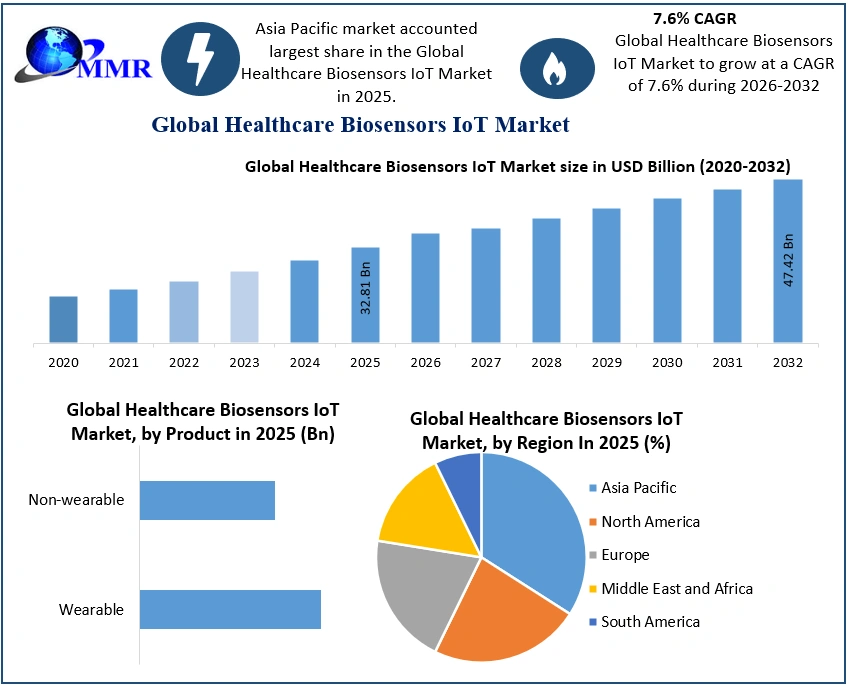
The market was valued at USD 32.81 Billion in 2025 and is projected to reach USD 47.42 Billion by 2032, expanding at a CAGR of 7.6%. The growth trajectory highlights increasing demand for connected diagnostics and healthcare monitoring tools that support decentralized care delivery.
Diabetes management remains a major adoption driver. Growing awareness around self-management has encouraged integration of advanced technology into glucose monitoring systems, supporting demand for biosensor-based healthcare devices.
Key Trends Driving Growth
The first major shift is the expansion of remote patient monitoring. Healthcare providers are adopting connected devices to track patient conditions outside hospitals, reducing dependence on frequent physical visits and supporting earlier clinical responses.
Wearable biosensors are gaining attention because they support continuous monitoring of physiological indicators. These technologies create opportunities for healthcare organizations to improve chronic disease management and develop more personalized care programs.
Digital health integration is another growth driver. Biosensors generate large volumes of health information that can be analyzed through connected platforms. AI-based analytics can support pattern recognition, risk identification, and clinical workflow improvements, although adoption depends on data security, regulatory compliance, and interoperability.
Point-of-care diagnostics are also expanding market opportunities. Biosensors capable of measuring biomarkers such as glucose, lactate, creatinine, and urea are being developed for clinical, laboratory, and self-testing applications.
Request a Free Sample Copy or View Report Summary
Segment Insights
- Dominant Segment: Wearable and Non-Wearable Biosensor Products
Product-based adoption remains central to the market, with wearable and non-wearable biosensors serving different healthcare needs. Wearable systems support continuous monitoring, while non-wearable solutions address diagnostic and clinical testing requirements. - Fastest-Growing Segment: Point-of-Care Testing and Home Healthcare Diagnostics
Point-of-care and home-based diagnostic applications are gaining momentum as healthcare providers seek faster testing and decentralized care models. These segments benefit from demand for convenient monitoring solutions and improved access to healthcare services. - Technology Segment: Electrochemical Biosensors
Electrochemical technology is widely used in healthcare applications, particularly glucose monitoring and biomarker detection. Its established commercial applications continue to support market expansion.
Regional Growth Story
North America remains a major market due to advanced healthcare infrastructure, high technology adoption, and strong demand for digital healthcare solutions. The United States continues to represent an important innovation hub for connected medical devices, remote monitoring platforms, and healthcare technology investments.
Europe is advancing through healthcare digitalization and adoption of connected medical solutions. Countries including Germany and the UK are focusing on healthcare efficiency, patient monitoring, and technology-supported care delivery.
Asia Pacific presents significant growth potential as healthcare systems in countries such as China, Japan, India, and South Korea expand digital healthcare infrastructure. Rising healthcare access, increasing technology adoption, and demand for affordable diagnostic solutions are creating opportunities for biosensor manufacturers.
Emerging markets are also creating demand for home healthcare diagnostics because connected solutions can improve healthcare reach beyond traditional hospital settings.
Competitive Landscape
The competitive environment includes medical technology companies, biosensor developers, and healthcare technology providers. Companies are focusing on product innovation, miniaturization, connectivity improvements, and integration with healthcare platforms.
Leading players identified in the market include Abbott Laboratories, Bio-Rad International, Biosensors International, DuPont Biosensors Materials, and Ercon Inc.
Competition is shifting from standalone devices toward connected healthcare ecosystems. Companies that combine accurate sensing technology with data platforms, analytics, and clinical integration are positioned to capture broader healthcare value.
Recent Developments
- Increasing integration of microchips and advanced electronics into glucose monitoring devices is improving accuracy and speed of testing, strengthening adoption in diabetes care.
- Development of biosensors for biomarkers including glucose, lactate, creatinine, and urea is expanding applications across diagnostics and self-testing markets.
- Healthcare technology companies are investing in connected monitoring platforms that support remote care and digital health workflows.
Strategic Implications
Healthcare providers are evaluating biosensors as tools to improve patient engagement, reduce avoidable interventions, and support value-based care models. Hospitals and healthcare networks can use connected monitoring to improve chronic disease management and strengthen outpatient care strategies.
For pharmaceutical and biotechnology companies, biosensor-generated real-world health data creates opportunities for treatment monitoring, clinical research, and precision medicine initiatives.
Investors are watching the sector because healthcare delivery is becoming increasingly data-driven. Companies that solve challenges around device accuracy, cybersecurity, reimbursement, and integration with healthcare systems will have stronger competitive positioning.
Regulators and payers will influence adoption by defining standards for safety, clinical reliability, and reimbursement pathways. Sustainable market growth will depend on proving measurable healthcare outcomes.
Future Outlook
The Healthcare Biosensors IoT Market is moving toward a connected care model where diagnostics, monitoring, and healthcare decisions become increasingly data-enabled. Growth will be shaped by demand for chronic disease management, home diagnostics, and intelligent healthcare platforms. Future leaders will be the companies that combine reliable biosensor technology with secure connectivity, clinical value, and scalable healthcare integration, while laggards will struggle to move beyond standalone devices.
Analyst Perspective
“Healthcare Biosensors IoT technologies are changing how healthcare systems approach monitoring and diagnostics. The next phase of growth will depend on stronger integration between biosensors, digital platforms, and clinical decision-making, creating opportunities across healthcare delivery, diagnostics, and life sciences innovation.”
— Komal Patil, Research Analyst
About Maximize Market Research
Maximize Market Research Pvt. Ltd. (MMR) is a global market research and consulting company that provides reliable, data-focused, and practical business insights. The firm serves a wide range of industries, including healthcare, pharmaceuticals, technology, automotive, electronics, chemicals, personal care, and consumer goods. Through market forecasts, competitive analysis, strategic consulting, and industry impact assessments, MMR helps organizations understand changing market conditions, identify growth opportunities, and make informed business decisions for long-term success.
2nd Floor, Navale IT Park Phase 3
Pune Banglore Highway, Narhe
Pune, Maharashtra 411041, India
+91 9607365656
sales@maximizemarketresearch.com

