
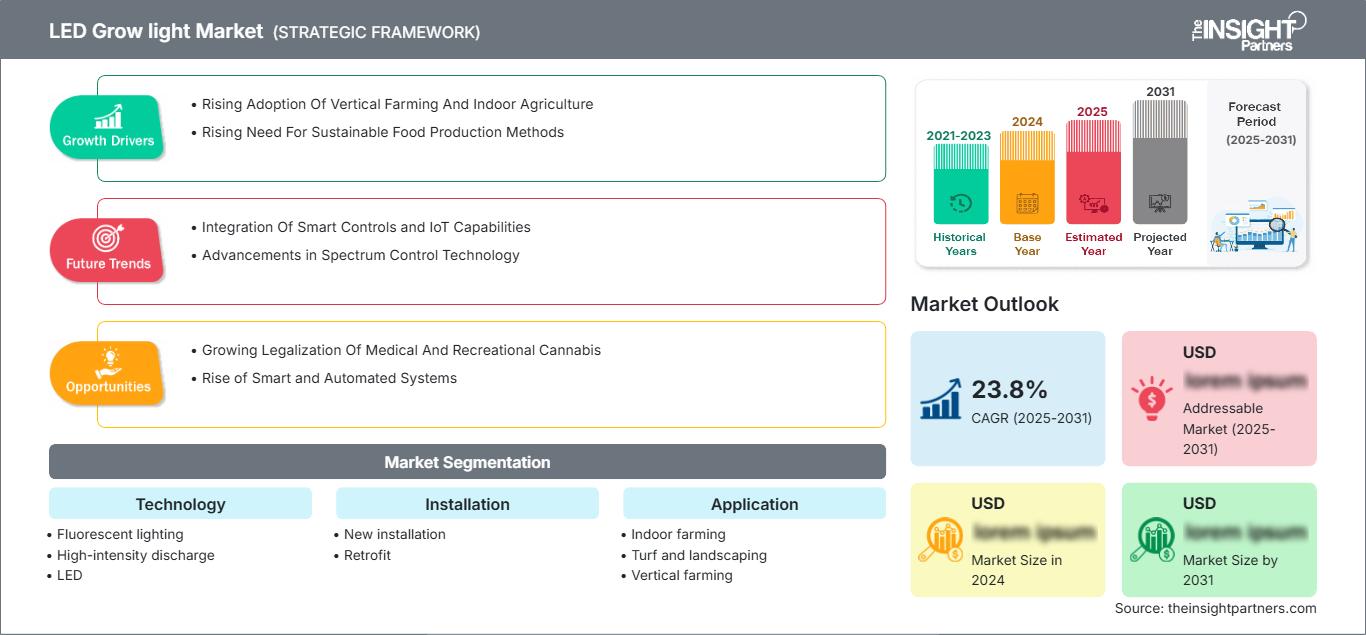
LED grow lights have emerged as one of the most advanced lighting technologies for controlled environment agriculture, enabling growers to optimize plant growth through precisely engineered light spectra while significantly reducing energy consumption compared to conventional lighting systems. These intelligent lighting solutions are extensively deployed across vertical farms, commercial greenhouses, indoor farming facilities, hydroponic systems, aquaponics, research laboratories, plant nurseries, cannabis cultivation, urban agriculture, and home gardening applications. LED grow lights deliver customized wavelengths that support photosynthesis, seed germination, vegetative growth, flowering, fruit production, and crop quality throughout the plant lifecycle. Continuous advancements in light-emitting diode technology, artificial intelligence, Internet of Things connectivity, wireless controls, and precision agriculture are transforming LED grow lighting into highly efficient, automated, and data-driven cultivation solutions. As concerns regarding food security, climate change, water conservation, and shrinking agricultural land continue increasing worldwide, LED grow lights are becoming essential technologies for sustainable year-round food production.
Market Overview
The LED Grow Light Market size is expected to reach US$ 5.31 billion by 2034 from US$ 1.24 billion in 2025. The market is anticipated to register a CAGR of 17.54% during the forecast period 2026–2034. Market growth is driven by expanding indoor farming operations, increasing adoption of vertical agriculture, rising investments in smart greenhouse technologies, growing demand for energy-efficient lighting systems, and continuous innovation in horticultural lighting solutions. Agricultural producers are increasingly deploying advanced LED grow lights to maximize crop productivity, improve operational efficiency, and reduce long-term cultivation costs.
Key Market Insights
- Market Size (2025): US$ 1.24 billion
- Forecast Market Size (2034): US$ 5.31 billion
- CAGR (2026–2034): 17.54%
- Key Growth Driver: Increasing adoption of indoor farming and controlled environment agriculture
- Major Trend: Artificial intelligence-enabled LED grow lighting integrated with precision farming platforms
- Forecast Period:2026–2034
Get a Sample PDF of the Report: https://www.theinsightpartners.com/sample/TIPRE00005018
Market Drivers
Expansion of Indoor Farming
Indoor farming is becoming increasingly popular as growers seek reliable methods for producing crops regardless of seasonal weather conditions. LED grow lights provide optimized illumination that supports continuous crop cultivation while improving productivity, consistency, and resource efficiency. Their ability to create ideal growing environments makes them indispensable for commercial indoor agriculture.
Growth of Vertical Farming
Vertical farming facilities rely extensively on LED grow lights to maximize production within compact indoor spaces. LED technology enables precise control of light intensity and wavelength while consuming considerably less electricity than conventional horticultural lighting systems. Growing investments in vertical farming continue driving demand for advanced LED lighting solutions.
Demand for Energy-Efficient Agriculture
Energy consumption represents one of the largest operational costs in controlled environment agriculture. LED grow lights offer significantly higher energy efficiency, longer operational lifespan, lower heat generation, and reduced maintenance requirements compared to traditional lighting technologies. These advantages encourage widespread replacement of older lighting systems with modern LED alternatives.
Increasing Focus on Food Security
Governments and agricultural organizations continue investing in technologies that enhance food production while minimizing environmental impact. LED grow lights support sustainable farming by enabling year-round cultivation, reducing dependence on climatic conditions, improving crop yields, and optimizing water and land utilization in modern agricultural systems.
Market Trends
Artificial Intelligence-Based Lighting Management
Artificial intelligence is increasingly being integrated into LED grow lighting systems to automatically optimize light intensity, photoperiod, and spectral composition based on plant growth stages and environmental conditions. Intelligent lighting control improves crop quality while reducing energy consumption and labor requirements.
Internet of Things Connectivity
LED grow lights are becoming part of connected agricultural ecosystems through Internet of Things integration. Smart lighting systems communicate with environmental sensors, irrigation equipment, climate control systems, and cloud-based management platforms to enable automated greenhouse operations and precision crop management.
Spectrum Customization Technology
Manufacturers continue developing LED grow lights capable of delivering highly customized light spectra tailored to specific plant species, growth phases, and production objectives. Precision spectrum engineering enhances photosynthesis, accelerates flowering, improves nutritional value, and increases overall crop quality.
Smart Greenhouse Automation
Modern greenhouse facilities increasingly combine LED grow lights with automated environmental controls, carbon dioxide management, irrigation systems, humidity regulation, and predictive analytics. Fully integrated cultivation platforms improve operational efficiency while maximizing agricultural productivity.
Get the Premium Research Report @ https://www.theinsightpartners.com/buy/TIPRE00005018
Regional Analysis
North America
North America remains a leading market due to expanding indoor farming operations, commercial cannabis cultivation, strong investments in agricultural technology, and increasing adoption of sustainable farming practices. Growing demand for locally produced food and advanced horticultural technologies continues supporting market expansion across the region.
Europe
Europe continues experiencing significant market growth driven by greenhouse modernization, increasing focus on sustainable agriculture, government support for energy-efficient farming technologies, and expanding adoption of controlled environment agriculture. Countries including the Netherlands, Germany, France, and the United Kingdom continue investing heavily in advanced horticultural lighting systems.
Asia-Pacific
Asia-Pacific is expected to register the fastest market growth owing to rapid urbanization, rising food demand, increasing agricultural modernization, government support for smart farming, and expanding investments in vertical agriculture. China, Japan, South Korea, Singapore, India, and Australia continue strengthening advanced agricultural production through intelligent LED lighting technologies.
Middle East and Africa
The Middle East and Africa are increasingly adopting LED grow lights to address water scarcity, food security, and harsh climatic conditions. Controlled environment agriculture supported by energy-efficient lighting technologies is becoming an important solution for enhancing agricultural productivity throughout the region.
Competitive Landscape
The LED Grow Light Market remains highly competitive as lighting manufacturers continue investing in advanced LED technology, artificial intelligence, Internet of Things connectivity, precision agriculture, and smart greenhouse solutions. Companies are focusing on improving lighting efficiency, spectral optimization, product durability, intelligent automation, and cloud integration while strengthening partnerships with greenhouse operators, vertical farming companies, agricultural technology providers, and research institutions.
Key Players
- Signify N.V.
- ams-OSRAM AG
- Gavita International B.V.
- Current Lighting Solutions LLC
- Fluence Bioengineering Inc.
- Heliospectra AB
- Valoya Oy
- Samsung Electronics Co., Ltd.
- Lumileds Holding B.V.
- Hortilux Schréder
Emerging Trends
The LED grow light industry continues advancing through artificial intelligence, precision agriculture, cloud-connected farming platforms, adaptive spectrum technology, automated greenhouse management, and advanced crop analytics. Manufacturers are developing intelligent lighting systems capable of predictive crop optimization, autonomous environmental adjustment, energy management, and seamless integration with comprehensive digital farming ecosystems. Increasing investments in urban agriculture, sustainable food production, climate-resilient farming, and vertical cultivation are expected to create significant opportunities for future market growth.
Future Outlook
The future outlook for the LED Grow Light Market remains exceptionally positive as controlled environment agriculture, vertical farming, and sustainable food production continue expanding worldwide. Growing investments in precision farming, smart greenhouse infrastructure, artificial intelligence, and energy-efficient agricultural technologies will continue driving strong market growth. Future innovations are expected to focus on enhanced energy efficiency, intelligent automation, advanced spectral engineering, cloud-based cultivation management, and fully integrated digital agriculture platforms.
Related Market Research Reports
Security Cameras Market Size, Share & Trends by 2034
Network Slicing Market Demand, Size & Forecast by 2034
Smart Waste Collection Market Share, Demand & Growth by 2034
Noise Monitoring Market Demand, Trends & Forecast by 2034
About The Partners
The Insight Partners is a Insight global leader in market research, delivering comprehensive analysis and actionable insights across diverse industries. The company empowers decision-makers with data-driven intelligence to navigate evolving markets and accelerate growth.
Contact Us:
- Contact Person: Ankit Mathur
- E-mail: ankit.mathur@theinsightpartners.com
- Phone: +1-646-491-9876
Also Available in :

