
Key Highlights
-
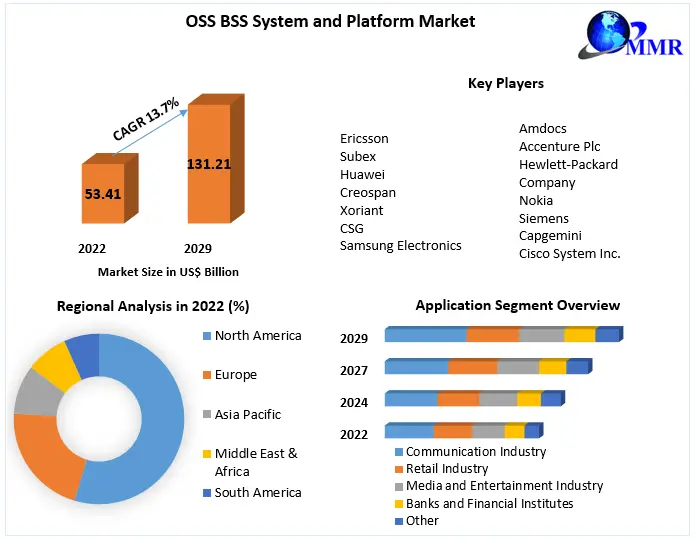
Market valuation expanding from US$ 53.41 Billion in 2022 to US$ 131.21 Billion by 2029.
-
Compound Annual Growth Rate sustained at 13.7% over the seven-year forecast window.
-
BSS dominated architectural market capture over standalone network monitoring frameworks.
-
Convergent billing systems emerge as the primary consumer acquisition and retention vector.
-
North America controlled a leading 40% regional market share allocation in 2022.
-
Top five system integrators and technology providers captured 40% of global revenue.
Why This Matters Now
Legacy telecommunications architectures are fracturing under the weight of modern application ecosystems and fragmented invoice delivery systems. Enterprise technology buyers and mobile network operators can no longer sustain disconnected, multi-vendor infrastructure models that isolate subscriber consumption data from underlying network provisioning. The financial imperative to tie complex multi-channel data, internet, video, and mobile commerce into a singular invoice is forcing immediate capital reallocation toward unified operational and business platforms.
What changed is the shift in customer buying patterns, as users now demand integrated service bundles under a consolidated bill rather than handling isolated invoices for separate communication layers. This operational change directly pressures communication service providers to execute radical system updates to mitigate churn and protect operating margins. Why now? Because system fragmentation directly limits service delivery speeds, leaving slower moving service providers exposed to market share erosion by agile competitors utilizing standardized frameworks.
Market Overview
The global OSS BSS System And Platform Market reached a valuation of US$ 53.41 Billion in 2022, and it is on a definitive trajectory to hit US$ 131.21 Billion by 2029. This growth represents a highly consistent CAGR of 13.7%, illustrating deep capital expenditure commitments by global telecommunications operators and corporate enterprises. This architectural investment spans across major industries, including the communication industry, retail industry, media and entertainment industry, and banks and financial institutes.
The underlying market structure balances operations support systems—covering network design, network monitoring, service fulfillment, and service assurance—with client-side business support systems encompassing customer management, revenue management, product management, and order management. As networks pivot to software-driven provisioning models, these backend layers serve as the foundational orchestration software necessary to scale modern corporate operations.
Key Trends Driving Growth
The rapid adoption of convergent billing systems stands as the primary technical catalyst across the global telecommunications sector. Modern communication service providers are broadening their operational offerings far beyond basic voice services, incorporating high-speed data, broadband internet, streaming video, rich multimedia, and mobile commerce into their core portfolios.
To maintain consumer engagement, operators are relying on convergent billing to provide an organized, single-invoice view across both prepaid and postpaid streams. OSS BSS solutions play a critical role in assembling these consolidated billing profiles, directly linking consumer actions with back-end financial software.
Simultaneously, the widespread deployment of standardized architectural frameworks is opening new channels for platform expansion. For years, service providers struggled with long process cycles, low data accuracy, and complex security issues related to confidential data management. The introduction of the New Generation Operations System (NGOSS)—formalized through the TM Forum Frameworx initiative—has established clear integration guidelines for equipment providers, system integrators, and service vendors. This standardization acts as a major market opportunity, directly reducing historical implementation times and simplifying cross-platform configurations.
Segment Insights
-
Dominant Segment: Business Support System (BSS) components captured the largest structural share of the global market in 2022. Within this space, customer management emerged as the leading operational sub-segment, driven by companies prioritizing client retention and digital interaction pathways, while revenue management software continued to command massive infrastructure investments.
-
Fastest-Growing Segment: Service assurance tools within the Operations Support System (OSS) segment are projected to deliver the highest growth rate during the forecast period. This rapid rise reflects a critical push by network operators to achieve real-time monitoring and automated fault resolution across increasingly complex data networks.
Regional Growth Story
North America commanded the global OSS BSS system and platform market in 2022, securing approximately 40% of the total market share. This dominant regional position stems directly from the rapid adoption of specialized service assurance, revenue management, and customer management solutions across the United States and Canada. The presence of a highly dense network of mature telecommunications groups and mobile network operators makes North America a key hub for architectural development. In this highly saturated environment, service differentiation is the main differentiator for retention, forcing regional operators to continuously update their client-facing systems.
Conversely, the Asia Pacific region is positioned to register the fastest growth through 2029, expanding at a significant CAGR. Historically, software deployment across developing nations like India and South Korea encountered substantial delays due to unfavorable regulatory landscapes and a lack of standardized data guidelines. However, upcoming compliance adjustments and infrastructure standardization initiatives are poised to unlock substantial regional demand. This regulatory shift will allow massive service networks across China, India, and Japan to integrate advanced automated business architectures at scale.
Competitive Landscape
The global OSS BSS marketplace remains highly fragmented, characterized by intense technological competition and low structural entry barriers for specialized software developers. Despite this ongoing influx of niche players, the top five market leaders managed to secure approximately 40% of total global revenues in 2022. The tier-one ecosystem is led by major technology entities, including Telefonaktiebolaget LM Ericsson, Amdocs Ltd., Accenture Plc, Hewlett-Packard Company, and Nokia Siemens, alongside prominent tech providers like Huawei, Subex, Creospan, Xoriant, CSG, Samsung Electronics, Nokia, Siemens, Capgemini, and Cisco System Inc.
To protect their market share against small software disruptors, these leading players are focusing on establishing long-term, multi-year alliances with tier-one mobile network operators. The prevailing industry strategy has shifted from selling standalone software licenses toward delivering comprehensive, all-inclusive OSS and BSS platforms alongside integrated service delivery platforms.
These comprehensive systems are increasingly offered through long-term contractual outsourcing or structured multi-year managed services. This approach allows enterprise vendors to lock in recurring revenues while giving operators predictable operating costs and a faster path to network modernization.
Recent Developments
-
Tier-one providers are shifting away from standalone software modules, prioritizing end-to-end service delivery platforms to streamline complex multi-vendor ecosystems.
-
Leading system integrators are actively forming long-term contractual partnerships with mobile operators to manage backend billing infrastructures on an outsourced basis.
-
Global network vendors are integrating automated service assurance software directly into their core network hardware to enable automated fault resolution.
-
Regulatory alignment with the TM Forum Frameworx guidelines has become a core development requirement for new enterprise billing software releases.
Strategic Implications
The consolidation of market revenue among a small group of large system integrators signals a clear shift toward complete platform dependency. Telecom operators can no longer afford the custom integration costs associated with combining independent, single-purpose software tools from different vendors. This reality gives massive pricing power to elite vendors capable of providing full-stack, pre-integrated solutions that span from the physical layer up to client-facing applications.
Enterprise buyers who continue to build custom, fractured backend systems risk locking themselves into high maintenance costs and slow product release cycles. For investment groups and technology providers, long-term market success depends entirely on aligning with standardized platform frameworks that facilitate rapid deployment across diverse cloud architectures.
Future Outlook
The next phase of market development will be defined by how effectively backend operating layers can adapt to real-time, automated adjustments. As service delivery frameworks move closer to the network edge to support ultra-low latency enterprise applications, legacy batch-processing billing architectures will become obsolete. Operational victory will belong to communication service providers that successfully transform their billing setups into live, continuous data engines capable of adjusting rates and provisioning resources automatically in response to shifting network demand.
The future marketplace will feature a sharp divide between highly agile, platform-driven communication leaders capable of deploying services instantly and legacy operational laggards burdened by rigid, disjointed billing systems.
Analyst Perspective
“The ongoing transition toward convergent billing systems is no longer just an operational upgrade; it is a baseline business requirement for survival in a multi-service digital landscape,” states Yash Ghosalkar, Lead Analyst at Maximize Market Research. “Operators who fail to transition toward unified, TM Forum-compliant architectures will find themselves locked out of high-margin enterprise service opportunities due to processing cycle delays and billing inaccuracies.”
About Maximize Market Research
Maximize Market Research Pvt. Ltd. (MMR) is a global market research and consulting company that provides reliable, data-focused, and practical business insights. The firm serves a wide range of industries, including healthcare, pharmaceuticals, technology, automotive, electronics, chemicals, personal care, and consumer goods. Through market forecasts, competitive analysis, strategic consulting, and industry impact assessments, MMR helps organizations understand changing market conditions, identify growth opportunities, and make informed business decisions for long-term success.
2nd Floor, Navale IT Park Phase 3
Pune Banglore Highway, Narhe
Pune, Maharashtra 411041, India
+91 9607365656
sales@maximizemarketresearch.com

