The demand for energy-efficient ventilation systems in North America has intensified significantly in recent years. As public awareness regarding indoor air quality (IAQ) grows alongside stricter government regulations on building energy consumption, Energy Recovery Ventilators (ERVs) have emerged as a vital technology. These systems play a crucial role in maintaining fresh airflow within residential, commercial, and industrial structures while minimizing the heating and cooling loads on HVAC systems.
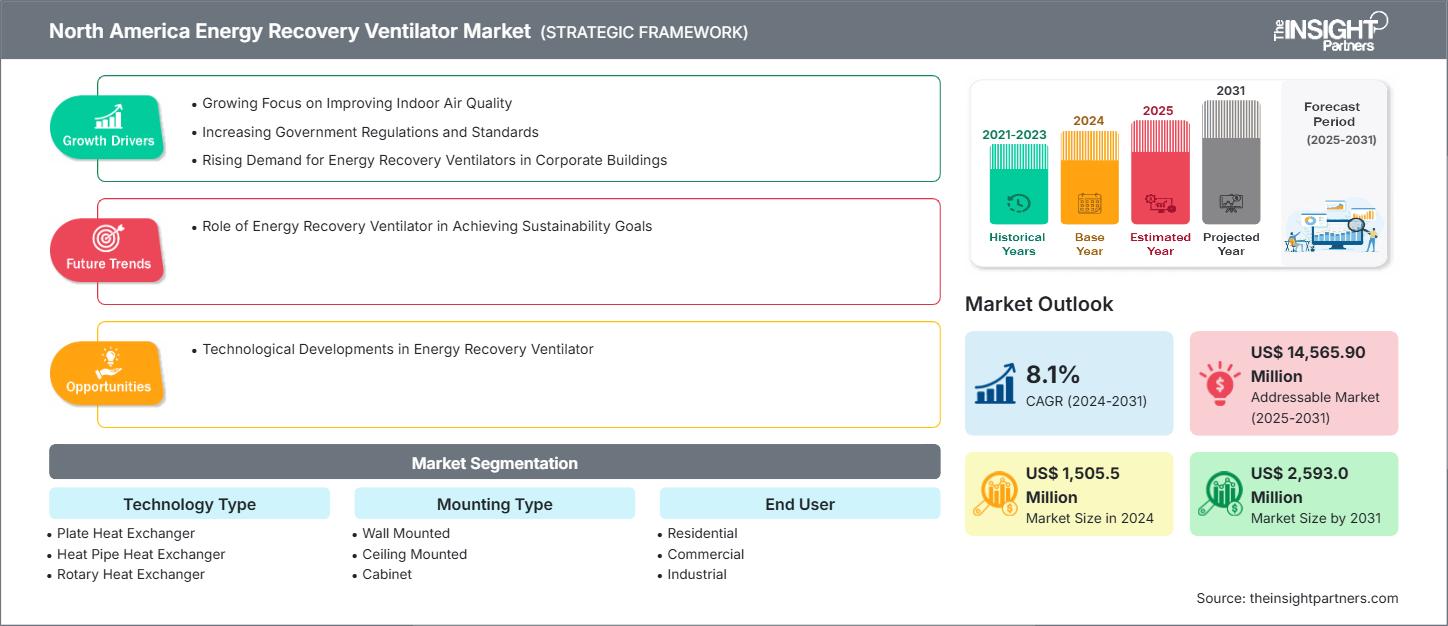
The North America Energy Recovery Ventilator Market size is expected to reach US$ 2,593.0 Million by 2031 from US$ 1,505.5 Million in 2024. The market is estimated to record a CAGR of 8.1% from 2024 to 2031. This steady economic trajectory underscores the rapid integration of advanced mechanical ventilation across the United States and Canada, driven by climate imperatives and modernization efforts.
Market Drivers and Technological Dynamics
An Energy Recovery Ventilator operates by exchanging the energy contained in normally exhausted building or space air and using it to treat the incoming outdoor ventilation air. In colder seasons, the system captures heat and moisture from the outgoing stale air to warm and humidify the incoming fresh air. Conversely, during warm summer months, the system cools and dehumidifies the incoming air. This continuous, balanced exchange substantially reduces the workload on core heating and cooling infrastructure, translating directly into lower utility bills for consumers and decreased carbon footprints for businesses.
Several factors are propelling the market forward in North America. First, regulatory frameworks such as the American Society of Heating, Refrigerating and Air-Conditioning Engineers (ASHRAE) standards and local green building codes have mandated higher ventilation rates without sacrificing energy efficiency. Second, the post-pandemic focus on health and wellness has permanently altered how building managers view indoor environments. Ensuring a continuous stream of filtered, outdoor air is no longer seen as a luxury but as a baseline necessity for health, productivity, and comfort.
Get a PDF Sample– https://www.theinsightpartners.com/sample/TIPRE00041708
Competitive Landscape and Key Players
The North American ERV market is characterized by the presence of established global HVAC giants as well as specialized ventilation equipment manufacturers. These entities continuously invest in research and development to introduce smart, IoT-enabled ERV units capable of adjusting airflow dynamically based on real-time indoor contaminant and humidity levels.
The prominent players driving innovation and holding significant market share include:
-
Panasonic Holdings Corp – Known for its highly efficient WhisperComfort series designed for residential applications.
-
Mitsubishi Electric Corp – Renowned for its Lossnay energy recovery technology, which utilizes a specialized paper core to optimize moisture and heat transfer.
-
LG Electronics Inc – Provides integrated HVAC solutions that blend seamlessly with eco-friendly smart home ecosystems.
-
Daikin Industries Ltd – A global leader offering robust commercial and residential ventilation systems that emphasize climate control efficiency.
-
Greenheck Fan Corp – A top-tier manufacturer focusing heavily on commercial-grade ventilation and customizable air-handling units.
-
Munters Group AB – Specializes in large-scale industrial desiccant and energy recovery technologies tailored for complex architectural demands.
-
Nortek Air Solutions, LLC – Delivers custom engineered HVAC solutions featuring innovative energy recovery components for data centers and hospitals.
-
FUJITSU GENERAL – Expands its presence by offering balanced ventilation units that pair efficiently with their ductless mini-split systems.
-
Carrier Global Corp – A cornerstone of the North American HVAC market, delivering comprehensive, energy-compliant residential and commercial ERVs.
-
Johnson Controls International Plc – Focuses on smart building architecture, embedding advanced ERV controls into automated facility management systems.
Get Full Copy of This Report–https://www.theinsightpartners.com/buy/TIPRE00041708
Future Outlook
The future of the North America Energy Recovery Ventilator market looks incredibly promising as the construction sector shifts permanently toward net-zero energy buildings (NZEBs). Over the next decade, the industry will likely see deeper integration of artificial intelligence and advanced sensor arrays within ERV units, allowing them to self-diagnose mechanical faults and automatically optimize energy exchange based on local weather forecasts. Furthermore, as federal tax incentives and state-level rebates for energy-efficient retrofits continue to expand under various clean energy acts, residential adoption is poised to surge. Manufacturers who prioritize compact designs, quiet operation, and simplified maintenance protocols will be well-positioned to capture the massive volume of suburban and urban redevelopment projects sweeping across the North American continent.
Related Reports-
About Us
The Insight Partners is a one-stop industry research provider of actionable intelligence. We help our clients in getting solutions to their research requirements through our syndicated and consulting research services. We specialize in industries such as Semiconductor and Electronics, Aerospace and Defense, Automotive and Transportation, Biotechnology, Healthcare IT, Manufacturing and Construction, Medical Devices, Technology, Media, and Telecommunications, as well as chemicals and Materials.
Contact Us
If you have any queries about this report or if you would like further information, don’t hesitate to get in touch with us:
Contact Person: Ankit Mathur
E-mail: ankit.mathur@theinsightpartners.com
Phone: +1-646-491-9876