Public Safety In-Building Wireless DAS Market
Key Highlights
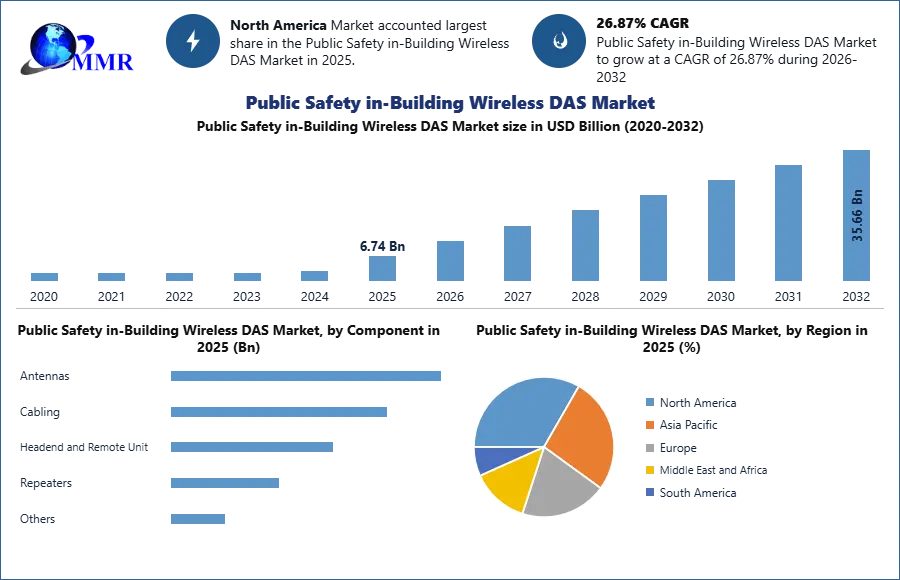
- The Public Safety In-Building Wireless DAS Market was valued at US$ 6.74 Billion in 2025.
- The market is expected to reach US$ 35.66 Billion by 2032.
- Revenue is projected to expand at a 26.87% CAGR during the forecast period.
- Growing 5G deployments are accelerating investments in in-building wireless infrastructure.
- Smart building initiatives are increasing enterprise demand for resilient public safety communications.
- Digital infrastructure modernization continues strengthening adoption across commercial, industrial, healthcare, transportation, and government facilities.
Why This Matters Now
Buildings have become digital infrastructure, and uninterrupted wireless connectivity is increasingly a public safety requirement rather than a convenience. Governments, enterprises, telecom operators, and infrastructure owners are investing in resilient indoor communication networks that support both emergency response and next-generation digital services.
The Public Safety In-Building Wireless DAS Market, expected to grow from US$ 6.74 Billion in 2025 to US$ 35.66 Billion by 2032 at a 26.87% CAGR, signals accelerating investment in mission-critical communications infrastructure. For telecom operators, equipment vendors, cloud providers, investors, and smart infrastructure developers, the market represents one of the fastest-growing segments within digital connectivity.
Market Overview
Public Safety In-Building Wireless Distributed Antenna Systems (DAS) have evolved from regulatory compliance solutions into strategic digital infrastructure. Modern buildings require reliable indoor wireless coverage to support first responders, emergency communications, operational continuity, and expanding enterprise connectivity requirements.
Urbanization, high-rise construction, smart city initiatives, and increasingly complex building environments are driving widespread deployment of distributed antenna systems. Traditional macro cellular networks often struggle to provide reliable indoor coverage, making dedicated in-building wireless infrastructure increasingly essential.
Digital transformation across healthcare facilities, airports, commercial offices, manufacturing plants, educational campuses, hotels, transportation hubs, and government buildings continues expanding demand for highly resilient wireless communications.
The market’s rapid expansion reflects growing recognition that indoor connectivity directly influences emergency response effectiveness, operational resilience, tenant experience, and long-term building value.
Key Trends Driving Growth
The global rollout of 5G networks is reshaping in-building wireless infrastructure strategies. Higher-frequency spectrum requires improved indoor signal distribution, increasing enterprise demand for advanced Distributed Antenna Systems capable of supporting both public safety and commercial wireless services.
Network modernization has become a major investment priority. Organizations increasingly deploy software-managed DAS architectures capable of supporting evolving wireless technologies while simplifying long-term infrastructure management.
Artificial intelligence is beginning to improve network operations through intelligent monitoring, predictive maintenance, automated fault detection, traffic optimization, and performance analytics. AI-assisted network management enables infrastructure operators to improve service reliability while reducing operational complexity.
Cloud-based network management platforms are also transforming infrastructure operations. Centralized visibility enables enterprises, telecom operators, and facility managers to remotely monitor network performance, optimize capacity, and accelerate maintenance activities across multiple locations.
Edge computing is emerging alongside intelligent buildings. Low-latency communications increasingly support connected security systems, building automation, industrial IoT devices, emergency response applications, and real-time operational analytics.
Enterprise demand continues expanding beyond regulatory compliance. Organizations increasingly view high-performance indoor wireless infrastructure as essential for digital transformation, hybrid workplaces, customer experience, operational efficiency, and business continuity.
Cybersecurity has become increasingly important as connected building infrastructure expands. Secure network architectures, identity management, encrypted communications, and resilient operational technology environments are becoming integral components of modern DAS deployments.
𝐃𝐨𝐰𝐧𝐥𝐨𝐚𝐝 𝐏𝐃𝐅 𝐁𝐫𝐨𝐜𝐡𝐮𝐫𝐞 @https://www.maximizemarketresearch.com/request-sample/95092/
Segment Insights
- Dominant Segment: The report identifies the leading market segment contributing the largest share of Public Safety In-Building Wireless DAS deployments through growing demand for reliable indoor critical communications infrastructure.
- Fastest-Growing Segment: The report identifies the fastest-growing segment driven by increasing adoption of advanced wireless technologies, enterprise digital infrastructure modernization, and expanding smart building investments.
Regional Growth Story
North America continues leading market adoption through strict public safety communication requirements, widespread 5G deployment, advanced commercial real estate infrastructure, and continued investment in digital building technologies. Enterprises increasingly integrate public safety communications into broader digital transformation initiatives.
Europe continues expanding investments in smart infrastructure, public safety modernization, and intelligent building connectivity. Regulatory requirements supporting emergency communications continue encouraging broader DAS deployment across commercial and public facilities.
Asia-Pacific represents one of the strongest long-term growth opportunities. China, India, Japan, and South Korea continue investing heavily in urban infrastructure, 5G deployment, transportation modernization, smart cities, and digital buildings, creating sustained demand for advanced in-building wireless systems.
The United States remains a major technology innovation hub where telecom operators, infrastructure providers, equipment manufacturers, and enterprise organizations continue accelerating deployment of intelligent indoor wireless networks supporting both commercial and mission-critical communications.
Competitive Landscape
Competition is evolving beyond radio coverage toward intelligent connectivity platforms. Vendors increasingly compete through software-defined network management, AI-enabled optimization, cloud integration, multi-operator support, and scalable infrastructure architectures.
Technology leadership increasingly depends on ecosystem integration. Building owners and enterprises prefer vendors capable of connecting DAS infrastructure with 5G networks, private wireless systems, IoT platforms, edge computing environments, and smart building management software.
Artificial intelligence is becoming an important competitive differentiator. Vendors investing in predictive analytics, autonomous network optimization, intelligent diagnostics, and AI-assisted performance management are positioning themselves for the next generation of digital infrastructure deployments.
The market also reflects growing collaboration among telecom operators, infrastructure providers, equipment manufacturers, cloud service providers, and smart building technology companies. These ecosystem partnerships enable comprehensive connectivity platforms rather than isolated wireless installations.
Pricing power will increasingly favor vendors capable of demonstrating measurable improvements in network reliability, emergency communications, operational efficiency, tenant experience, and long-term infrastructure scalability.
Recent Developments
- Global 5G deployments continue accelerating investment in indoor wireless infrastructure.
- Smart building projects are increasing enterprise demand for integrated DAS solutions.
- Cloud-based network management platforms are improving operational visibility.
- AI-enabled monitoring is enhancing network optimization and predictive maintenance.
- Organizations continue modernizing critical communications infrastructure to improve emergency response capabilities.
Strategic Implications
Technology providers should position Public Safety In-Building Wireless DAS as foundational digital infrastructure supporting enterprise connectivity, public safety, smart buildings, and future 5G expansion. Integration with AI, cloud platforms, edge computing, and intelligent network management will become essential competitive capabilities.
Telecom operators increasingly view in-building wireless infrastructure as a strategic extension of national 5G deployments. Reliable indoor coverage strengthens customer experience while expanding opportunities for enterprise connectivity services and private wireless solutions.
For investors, the market represents a convergence of telecommunications infrastructure, smart buildings, cloud networking, AI-powered operations, edge computing, cybersecurity, and digital infrastructure modernization. This convergence creates sustained long-term opportunities as indoor wireless connectivity becomes a critical component of future digital economies.
Future Outlook
The next phase of Public Safety In-Building Wireless DAS will move beyond signal amplification toward intelligent, AI-managed connectivity platforms that seamlessly integrate 5G, private wireless networks, edge computing, and smart building ecosystems into resilient digital infrastructure.
Organizations that deploy software-defined, AI-enabled, and future-ready in-building wireless platforms will define the next generation of connected infrastructure leadership, while those relying on legacy indoor communications systems risk falling behind in resilience, operational efficiency, regulatory readiness, and digital competitiveness.
Analyst Perspective
“Public Safety In-Building Wireless DAS is evolving into strategic digital infrastructure that supports emergency communications, enterprise connectivity, and smart building transformation simultaneously. Organizations investing in AI-enabled, software-defined, and 5G-ready wireless platforms will strengthen resilience, improve operational performance, and build long-term competitive advantage.” — Yash Ghosalkar
About Maximize Market Research
Maximize Market Research Pvt. Ltd. (MMR) is a global market research and consulting company that provides reliable, data-focused, and practical business insights. The firm serves a wide range of industries, including healthcare, pharmaceuticals, technology, automotive, electronics, chemicals, personal care, and consumer goods. Through market forecasts, competitive analysis, strategic consulting, and industry impact assessments, MMR helps organizations understand changing market conditions, identify growth opportunities, and make informed business decisions for long-term success.
2nd Floor, Navale IT Park Phase 3
Pune Banglore Highway, Narhe
Pune, Maharashtra 411041, India
+91 9607365656
sales@maximizemarketresearch.com