
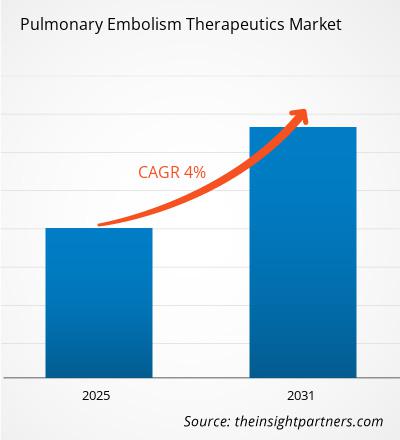
According to The Insight Partners, the Pulmonary Embolism Therapeutics Market was valued at US$ 4.95 billion in 2025 and is projected to reach US$ 8.9 billion by 2034, registering a CAGR of 6.74% from 2026 to 2034.
The Pulmonary Embolism Therapeutics Market is witnessing significant growth due to the increasing prevalence of venous thromboembolism (VTE), rising awareness regarding early diagnosis, and continuous advancements in anticoagulant and thrombolytic therapies. Pulmonary embolism (PE) is a potentially life-threatening condition caused by a blockage in one of the pulmonary arteries, usually resulting from blood clots that travel from the legs.
Get a Sample PDF – https://www.theinsightpartners.com/sample/TIPRE00014950
The growing burden of cardiovascular disorders, sedentary lifestyles, obesity, and aging populations is driving demand for effective pulmonary embolism treatment solutions worldwide. Pharmaceutical companies are investing heavily in research and development to introduce safer and more efficient therapeutic options, further supporting market expansion.
Increasing adoption of direct oral anticoagulants (DOACs), advancements in catheter-directed therapies, and favorable clinical outcomes associated with innovative treatment approaches are contributing to market growth. Furthermore, improvements in healthcare infrastructure and the availability of advanced diagnostic technologies are enabling timely detection and treatment of pulmonary embolism, creating substantial opportunities for market participants.
Market Growth Drivers
The rising incidence of deep vein thrombosis (DVT) and pulmonary embolism remains one of the primary drivers of the market. Risk factors such as prolonged immobility, cancer, obesity, major surgeries, and cardiovascular diseases continue to increase globally, resulting in a larger patient pool requiring therapeutic intervention. Healthcare providers are increasingly emphasizing preventive care and early treatment, which is accelerating the adoption of pulmonary embolism therapeutics.
Additionally, the introduction of novel anticoagulants has transformed the treatment landscape. Compared to traditional therapies such as warfarin, newer oral anticoagulants offer improved safety profiles, reduced monitoring requirements, and enhanced patient compliance. These advantages have encouraged physicians and healthcare institutions to adopt advanced therapeutic regimens, thereby boosting market growth.
Emerging Trends in the Pulmonary Embolism Therapeutics Market
Technological advancements and innovation are shaping the future of the pulmonary embolism therapeutics industry. Catheter-directed thrombolysis and mechanical thrombectomy devices are gaining traction for treating high-risk and intermediate-risk pulmonary embolism cases. These minimally invasive procedures help restore blood flow rapidly while reducing complications associated with systemic thrombolytic therapy.
Another notable trend is the increasing focus on personalized medicine. Healthcare providers are leveraging patient-specific risk assessments and clinical data to tailor treatment strategies, improving outcomes and reducing adverse events. Furthermore, digital health technologies and remote patient monitoring solutions are enhancing treatment adherence and follow-up care, contributing to better disease management.
Segment Analysis
Based on drug class, the anticoagulants segment dominates the pulmonary embolism therapeutics market due to its widespread use in preventing clot formation and recurrence. Direct oral anticoagulants continue to gain popularity because of their convenience and effectiveness. Thrombolytic agents also represent a significant market segment, particularly for patients experiencing severe pulmonary embolism requiring immediate intervention.
By distribution channel, hospital pharmacies account for a major share of the market owing to the high number of hospitalized pulmonary embolism cases requiring intensive treatment and monitoring. Retail pharmacies and online pharmacies are also witnessing growth as oral anticoagulant prescriptions increase globally.
Regional Insights
North America holds a substantial share of the pulmonary embolism therapeutics market due to advanced healthcare systems, high awareness levels, favorable reimbursement policies, and strong presence of leading pharmaceutical manufacturers. The United States remains the largest contributor within the region, supported by growing incidences of cardiovascular diseases and increasing healthcare expenditure.
Europe follows closely, driven by robust healthcare infrastructure and rising adoption of innovative treatment options. Countries such as Germany, France, and the United Kingdom are actively investing in advanced pulmonary embolism management solutions.
Meanwhile, the Asia-Pacific region is expected to register the fastest growth during the forecast period. Expanding healthcare access, increasing awareness regarding thromboembolic disorders, growing geriatric populations, and rising investments in healthcare infrastructure are creating lucrative opportunities across countries such as China, India, Japan, and South Korea.
Competitive Landscape
The pulmonary embolism therapeutics market is highly competitive, with major pharmaceutical companies focusing on product innovation, strategic collaborations, acquisitions, and clinical research initiatives to strengthen their market positions. Industry participants are continuously working toward developing safer anticoagulants and advanced therapeutic solutions to address unmet clinical needs.
Key Players in the Pulmonary Embolism Therapeutics Market
- Daiichi Sankyo Co. Ltd.
- Boehringer Ingelheim International GmbH
- Johnson and Johnson Services Inc
- Genentech
- Insera Therapeutics, Inc
- Bristol-Myers Squibb Co.
- F. Hoffman-La Roche Ltd.
- Roche
- Fresenius Kabi USA
- Pfizer Inc.
These organizations continue to invest in innovative drug development programs and strategic partnerships to expand their product portfolios and improve treatment outcomes for pulmonary embolism patients globally.
Future Outlook
The future of the pulmonary embolism therapeutics market appears promising as healthcare providers increasingly prioritize early diagnosis and effective disease management. Growing adoption of direct oral anticoagulants, advancements in interventional treatment procedures, and ongoing clinical research activities are expected to drive substantial market growth through 2034.
Furthermore, increasing awareness campaigns conducted by healthcare organizations and government agencies are expected to improve patient education regarding risk factors and symptoms associated with pulmonary embolism. As a result, earlier diagnosis and treatment initiation will likely contribute to improved patient outcomes and increased demand for advanced therapeutics.
Get Premium Research Report Market Size and Report at:
https://www.theinsightpartners.com/buy/TIPRE00014950
With continued innovation and expanding access to healthcare services worldwide, the pulmonary embolism therapeutics market is well-positioned for sustained growth throughout the forecast period.
About Us
The Insight Partners is a one-stop industry research provider of actionable intelligence. We help our clients in getting solutions to their research requirements through our syndicated and consulting research services. We specialize in industries such as Semiconductor and Electronics, Aerospace and Defense, Automotive and Transportation, Biotechnology, Healthcare IT, Manufacturing and Construction, Medical Device, Technology, Media and Telecommunications, Chemicals and Materials.
Contact Us
Ankit Mathur | The Insight Partners
E-mail: ankit.mathur@theinsightpartners.com
Phone: +1-646-491-9876
Also Available in : Korean | German | Japanese | French | Chinese | Italian | Spanish
