
Key Highlights
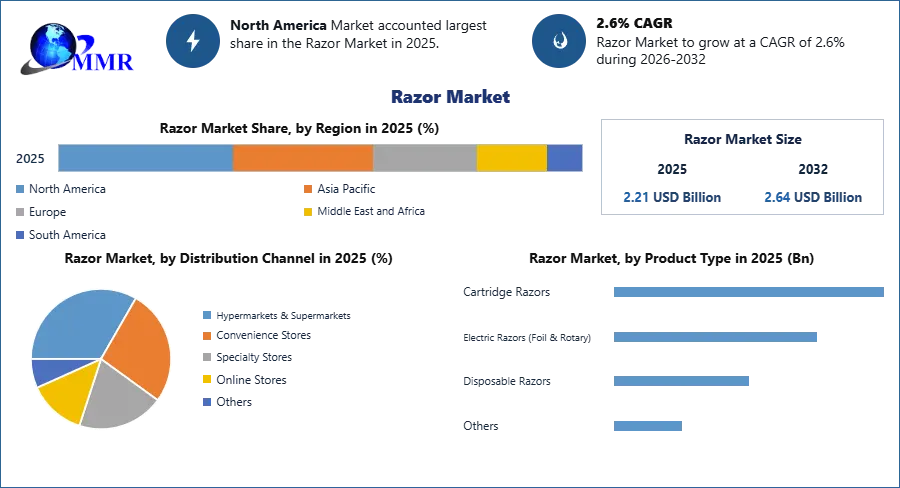
- Razor Market valued at USD 2.21 Billion in 2025
- Forecast to reach USD 2.64 Billion by 2032
- CAGR projected at 2.6% during 2026–2032
- Rising integration of electronics in grooming devices supports steady demand
- Expansion linked to consumer lifestyle upgrades and personal care innovation cycles
- Increasing relevance of semiconductor components in electric grooming systems
Why This Matters Now
Consumer grooming is shifting from purely mechanical tools to electronically enhanced devices. Even incremental upgrades in motor efficiency, battery life, and skin-sensing capabilities are reshaping product design cycles. For electronics manufacturers, this creates a niche but consistent demand stream for low-power semiconductors, embedded control systems, and battery management ICs.
The Razor Market’s steady CAGR signals a mature but resilient category where innovation is driven not by disruption, but by component-level engineering improvements. This positions the sector as a stable downstream demand driver for consumer electronics supply chains.
Market Overview
The Razor Market is transitioning through a phase defined by incremental electronic integration rather than structural disruption. Valued at USD 2.21 Billion in 2025, the market reflects sustained global consumption of grooming products across urban populations and expanding middle-income demographics.
Growth to USD 2.64 Billion by 2032 at a CAGR of 2.6% indicates a stable replacement-driven market. The expansion is not volume-led alone but influenced by premiumization of grooming devices, particularly electric razors that incorporate compact motors, rechargeable battery systems, and increasingly efficient electronic controls.
From an electronics and semiconductor standpoint, the market’s relevance is concentrated in embedded systems, low-power chipsets, and micro-level motor control architectures used in electric grooming devices.
Key Trends Driving Growth
A major shift is the electrification of personal grooming tools. Electric razors now rely on integrated circuits for speed regulation, torque optimization, and battery efficiency management. This creates a steady pull for semiconductor content per device, even in a traditionally low-electronics category.
Battery innovation is another key driver. Lithium-ion and fast-charging systems require dedicated power management ICs, which enhances the semiconductor intensity of grooming products. Manufacturers are focusing on longer lifecycle products with faster charging and energy-efficient motors.
Consumer demand for convenience is also reshaping product design. Compact, travel-friendly grooming devices are increasingly embedded with smart indicators, charging optimization chips, and safety cut-off systems. These features, while incremental, collectively increase electronic component density per unit.
Supply chain stability in consumer electronics has also improved post-pandemic disruptions, allowing OEMs to optimize sourcing for motors, blades, and semiconductor components. However, pricing sensitivity remains high, limiting aggressive technological overengineering.
Explore detailed analysis, insights, and growth opportunities
Segment Insights
- Dominant Segment: Not explicitly specified in the provided report data
- Fastest-Growing Segment: Not explicitly specified in the provided report data
- Electric razors are increasingly linked with semiconductor-driven control modules and battery systems
- Manual razors continue to represent a mechanically dominant category with minimal electronics integration
- Premium grooming devices show higher adoption of rechargeable systems and microcontroller-based controls
- Product differentiation is increasingly driven by electronic features rather than blade design alone
The absence of explicit segmentation data highlights a key industry reality: innovation is occurring within device functionality rather than market restructuring.
Regional Growth Story
The Razor Market operates across all major consumer regions including North America, Europe, Asia-Pacific, and emerging economies. However, the provided dataset does not specify regional revenue shares or growth leadership.
From an electronics manufacturing perspective, Asia-Pacific remains structurally important due to its broader role in consumer electronics production ecosystems, including motors, batteries, and semiconductor packaging. North America and Europe continue to drive premium product adoption, where higher electronic integration in grooming devices is more common.
China, Japan, South Korea, and India play critical roles in electronics supply chains, particularly in component manufacturing and assembly. Meanwhile, the United States and Germany remain influential in design innovation, battery technology, and premium consumer grooming product engineering.
Competitive Landscape
Competition in the Razor Market is shaped less by disruptive entry and more by incremental engineering advancement and brand positioning. Established personal care and grooming companies dominate through supply chain integration and distribution scale.
Strategically, competitive advantage is increasingly tied to electronic differentiation. Firms investing in better motor control systems, quieter operation, and longer battery life are effectively increasing semiconductor intensity within their product lines.
This shift signals a gradual convergence between consumer grooming and consumer electronics. Companies that successfully integrate embedded electronics into grooming platforms gain pricing resilience and premium segmentation advantages. Conversely, manufacturers relying solely on mechanical differentiation risk commoditization.
For semiconductor suppliers, this represents a micro-expansion opportunity in low-power ICs, battery management chips, and compact motor controllers tailored for consumer-grade applications.
Recent Developments
- Increased adoption of rechargeable grooming devices with enhanced battery management systems
- Expansion of compact motor technologies enabling quieter and more efficient electric razors
- Rising integration of low-power control electronics in consumer personal care devices
- OEM focus on premium grooming devices with extended lifecycle and faster charging capability
- Supply chain optimization in consumer electronics components supporting stable razor production cycles
Strategic Implications
The Razor Market is no longer purely a mechanical consumer goods category. It is evolving into a hybrid segment where electronics integration defines product value. This creates a downstream opportunity for semiconductor firms focusing on low-power, high-efficiency components.
For OEMs, the strategic priority is incremental innovation rather than radical redesign. Small gains in battery efficiency, motor control precision, and device intelligence translate directly into higher margins and brand differentiation.
For investors, the market represents a stable but low-volatility consumer electronics adjacency. Growth is limited, but resilience is strong due to recurring replacement demand cycles.
Supply chain players must increasingly treat grooming devices as part of the broader consumer electronics ecosystem rather than traditional FMCG hardware.
Future Outlook
The Razor Market will continue its steady trajectory toward USD 2.64 Billion by 2032, but its real transformation lies in the silent expansion of embedded electronics across everyday grooming devices. As semiconductor content per unit rises gradually, market leadership will belong to companies that treat grooming tools as intelligent edge devices rather than mechanical accessories.
Analyst Perspective
“Electronics integration is redefining value creation in the Razor Market, where incremental semiconductor adoption is steadily reshaping product architecture and competitive positioning,” said Rucha Deshpande, Analyst, Maximize Market Research.
About Maximize Market Research
Maximize Market Research Pvt. Ltd. (MMR) is a global market research and consulting company that provides reliable, data-focused, and practical business insights. The firm serves a wide range of industries, including healthcare, pharmaceuticals, technology, automotive, electronics, chemicals, personal care, and consumer goods. Through market forecasts, competitive analysis, strategic consulting, and industry impact assessments, MMR helps organizations understand changing market conditions, identify growth opportunities, and make informed business decisions for long-term success.
Contact Us :
2nd Floor, Navale IT Park Phase 3
Pune Banglore Highway, Narhe
Pune, Maharashtra 411041, India
+91 9607365656
sales@maximizemarketresearch.com

