Key Highlights
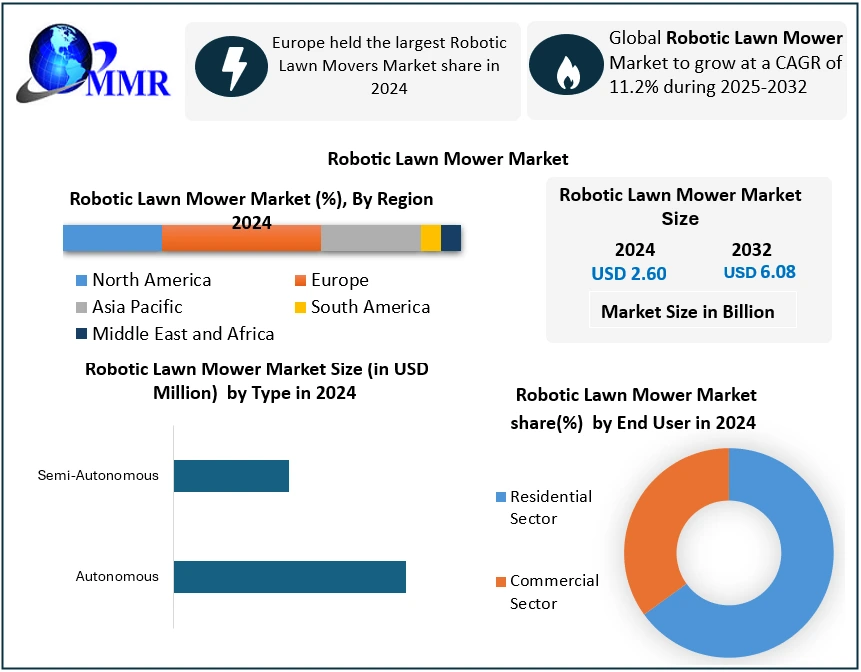
- The market was valued at USD 2.60 billion in 2024.
- Revenue is forecast to reach USD 6.08 billion by 2032.
- The market is expected to grow at a 11.2% CAGR.
- Europe accounted for the largest market share in 2024.
- Residential users remain the largest customer segment.
- Medium-range robotic mowers dominate product demand.
- AI navigation, GPS positioning, and smart connectivity are driving product innovation.
- Battery-powered robotic mowers support sustainability and zero-emission landscaping.
Why This Matters Now
Consumer expectations are shifting toward automated outdoor maintenance as smart home ecosystems become mainstream. Robotic lawn mowers reduce manual labor, lower operating emissions, and improve lawn maintenance efficiency. At the same time, advances in artificial intelligence, satellite positioning, and connected home technologies are transforming robotic mowers into intelligent outdoor automation platforms rather than standalone gardening equipment.
Market Overview
The Robotic Lawn Mower Market includes autonomous and semi-autonomous machines designed to mow residential and commercial lawns with minimal human intervention. These systems use GPS, artificial intelligence, cameras, sensors, and wireless connectivity to automate lawn maintenance while improving precision and efficiency.
Growing adoption of smart home technologies remains the primary market driver. Consumers increasingly prefer connected devices capable of automating repetitive household tasks, and lawn care is becoming part of this digital ecosystem.
Environmental sustainability is also strengthening demand. Battery-powered robotic mowers eliminate direct emissions while producing significantly lower noise than conventional gasoline-powered equipment. These advantages align with global efforts to reduce carbon emissions and encourage cleaner residential technologies.
The market also benefits from urbanization, expanding residential developments, rising disposable incomes, and increasing investment in premium home landscaping.
However, relatively high purchase costs continue limiting adoption among budget-conscious consumers, particularly in developing economies where traditional lawn mowers remain more affordable.
Key Trends Driving Growth
AI-Based Navigation Systems
Manufacturers continue integrating artificial intelligence, computer vision, and intelligent mapping technologies that allow robotic mowers to navigate increasingly complex landscapes with minimal human supervision.
Wire-Free Installation
Satellite-based positioning technologies such as EPOS eliminate the need for traditional boundary wires, simplifying installation while providing greater flexibility for homeowners.
Smart Home Integration
Robotic mowers are increasingly compatible with platforms including Amazon Alexa and Google Home, enabling voice control and centralized smart home management.
Sustainable Outdoor Equipment
Battery-powered operation supports zero-emission landscaping while reducing fuel consumption and operating noise, making robotic mowers increasingly attractive to environmentally conscious consumers.
Premium Consumer Segment Expansion
Manufacturers are introducing advanced premium models featuring intelligent mapping, weather adaptation, obstacle recognition, and remote smartphone control to target higher-income residential customers.
Explore detailed analysis, insights, and growth opportunities
Segment Insights
Dominant Segment: Medium-Range Robotic Lawn Mowers
Medium-range robotic lawn mowers accounted for the largest market share in 2024.
These products offer an effective balance between performance, affordability, battery life, and intelligent functionality, making them well suited for medium-sized residential properties.
Consumers increasingly prefer this category because it delivers advanced navigation, smartphone connectivity, and obstacle detection without the premium pricing associated with commercial-grade systems.
Business Impact
- Larger addressable consumer market
- Faster adoption among suburban homeowners
- Higher sales volumes for manufacturers
- Balanced pricing improves market accessibility
Fastest-Growing Segment: Residential End Users
The residential sector continues to represent the fastest-growing end-user segment.
Growing smart home adoption, changing lifestyles, and increasing demand for automated household maintenance continue accelerating residential purchases.
Manufacturers are expanding product portfolios with models designed for different lawn sizes, terrain conditions, and landscaping complexity.
Business Impact
- Expands recurring consumer demand
- Encourages premium feature adoption
- Increases software and app ecosystem opportunities
- Supports long-term product replacement cycles
Additional Key Sub-segments
Autonomous Robotic Mowers
Fully autonomous systems continue gaining market share due to improved navigation accuracy and reduced user intervention.
GPS and Vision-Based Navigation
GPS/GNSS navigation, camera-based vision systems, and AI mapping technologies are replacing traditional boundary-wire installations.
These technologies improve mowing precision while simplifying installation and setup.
Online Distribution
Digital sales channels continue expanding as consumers increasingly compare products online and purchase directly from manufacturers or e-commerce platforms.
Battery Capacity
Higher-capacity battery models are gaining popularity among users with larger properties requiring longer continuous mowing operations.
Regional Growth Story
Europe
Europe maintained the leading market position in 2024.
High environmental awareness, widespread smart home adoption, government incentives supporting sustainable technologies, and premium consumer spending continue driving regional demand.
Germany remains one of Europe’s largest robotic mower markets due to strong purchasing power, technological adoption, and consumer preference for premium outdoor equipment.
North America
North America continues experiencing strong demand as homeowners increasingly invest in automated landscaping equipment integrated with connected home technologies.
Commercial landscaping companies are also adopting robotic solutions to reduce labor costs and improve operational efficiency.
Asia Pacific
Asia Pacific presents significant long-term growth opportunities supported by rising urbanization, increasing disposable incomes, expanding smart home adoption, and growing residential construction activity.
China and Japan remain important manufacturing and technology development hubs.
Middle East, Africa, and South America
Although market penetration remains relatively low, increasing residential development and growing awareness of automated landscaping solutions are gradually supporting future expansion.
Competitive Landscape
Competition is increasingly centered on artificial intelligence, autonomous navigation, smart connectivity, and premium consumer experiences rather than conventional mowing performance.
Husqvarna Group continues leading technology innovation through satellite-based EPOS positioning, strengthening its leadership in premium wire-free robotic mowing systems.
Toro Company is expanding its intelligent mower portfolio with AI-powered navigation designed to improve autonomous operation and user convenience.
Bosch is strengthening its competitive position by integrating robotic mowers into broader smart home ecosystems, increasing product value through connected automation.
WORX (Positec) continues enhancing computer vision and edge-cutting technologies, targeting homeowners seeking affordable intelligent lawn maintenance.
STIHL is expanding into larger residential and commercial landscapes through rugged robotic mowers designed for challenging terrain.
Other major participants—including John Deere, Greenworks Tools, Mammotion, EcoFlow, STIGA, AL-KO Geräte GmbH, Zucchetti Centro Sistemi (Ambrogio Robot), Belrobotics, Gardena, LG Electronics, Yamabiko Corporation, SUMEC Corporation (Yard Force), Zhejiang Tianchen Intelligence & Technology, Hangzhou Favor Robot Technology, Mamibot, and NIKO Robotics—continue investing in autonomous navigation, AI-enabled mowing, battery innovation, and smart ecosystem integration.
The competitive landscape increasingly favors manufacturers capable of combining autonomous mobility, intelligent software, and seamless digital connectivity into premium consumer products.
Recent Developments
- March 2024: STIHL introduced the iMOW EVO series designed for rough terrain and large residential landscapes.
- April 2024: WORX upgraded its Landroid Vision robotic mower with enhanced AI obstacle detection and improved edge-cutting capabilities.
- May 2024: Toro Company expanded its AI-driven robotic mower lineup featuring autonomous vision-based navigation and smartphone connectivity.
- June 2024: Bosch launched new Indego models with deeper integration into Amazon Alexa and Google Home ecosystems.
- July 2024: Husqvarna introduced the next-generation Automower NERA series featuring satellite-based EPOS positioning for fully wire-free installation.
Future Outlook
Manufacturers that combine AI-powered navigation, wire-free operation, and seamless smart home integration will secure the strongest competitive advantage as autonomous outdoor maintenance becomes a standard feature of connected residential living.
About Maximize Market Research
Maximize Market Research Pvt. Ltd. (MMR) is a global market research and consulting company that provides reliable, data-focused, and practical business insights. The firm serves a wide range of industries, including healthcare, pharmaceuticals, technology, automotive, electronics, chemicals, personal carec, and consumer goods. Through market forecasts, competitive analysis, strategic consulting, and industry impact assessments, MMR helps organizations understand changing market conditions, identify growth opportunities, and make informed business decisions for long-term success.
Contact Us :
2nd Floor, Navale IT Park Phase 3
Pune Banglore Highway, Narhe
Pune, Maharashtra 411041, India
+91 9607365656
sales@maximizemarketresearch.com