
Key Highlights
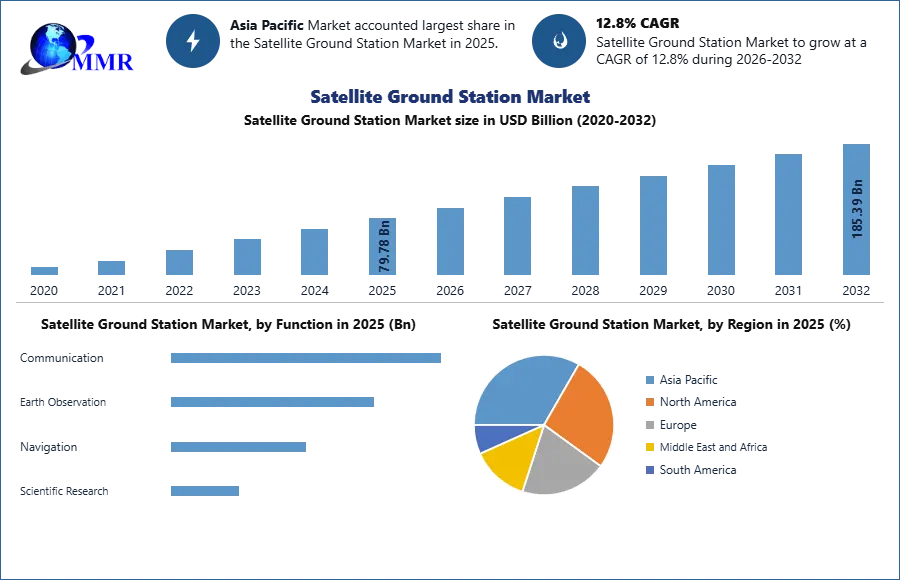
- Market valued at USD 79.78 Billion in 2025, projected to reach USD 185.39 Billion by 2032
- CAGR of 12.8% signals sustained expansion in space communication infrastructure
- Rising satellite launches increase demand for ground-based data handling systems
- Defense and commercial satellite networks driving capacity expansion
- Growing reliance on high-throughput, low-latency communication systems
- Ground stations emerging as strategic nodes in space operations architecture
Why This Matters Now
Defense contractors, satellite operators, and aerospace investors are entering a phase where ground infrastructure capacity is becoming a binding constraint. Satellite launches are scaling faster than terrestrial control systems, forcing accelerated investment decisions.
With the market expected to more than double by 2032, ground stations are no longer auxiliary assets. They are becoming core infrastructure for space-enabled defense, intelligence, and commercial connectivity systems.
Market Overview
The Satellite Ground Station Market Size covers terrestrial infrastructure used to communicate with orbiting satellites, including telemetry, tracking, command, and data reception systems. According to the supplied report, the market is valued at USD 79.78 billion in 2025 and is projected to reach USD 185.39 billion by 2032, growing at a CAGR of 12.8% from 2026 to 2032
This expansion reflects rising global dependence on satellite-based services across communication, navigation, defense surveillance, and Earth observation. As satellite constellations expand, ground infrastructure must scale in parallel to handle increased data flow and mission complexity.
The report does not specify segmentation, regional dominance, or competitive landscape details, but the magnitude of growth indicates strong multi-sector adoption across aerospace ecosystems.
Key Trends Driving Growth
The primary growth driver identified in the report is increasing demand for satellite communication infrastructure. This demand is directly linked to the rising number of satellite launches and expanding use of space-based data services.
The industry is shifting toward higher data throughput requirements. Modern satellites generate significantly larger datasets, requiring ground systems capable of near-real-time reception and processing.
Another structural trend is the expansion of global satellite networks, including multi-orbit architectures. These systems increase the frequency of satellite passes over ground stations, intensifying operational demand.
While the report does not detail defense or UAV integration, the scale of expansion suggests strong alignment with broader aerospace modernization programs and space-based intelligence requirements.
Explore detailed analysis, insights, and growth opportunities
Segment Insights
Dominant Segment: Not specified in the report
Fastest-Growing Segment: Not specified in the report
The report does not provide segmentation by type, application, or end-use categories. However, overall market growth suggests simultaneous expansion across commercial communication satellites and defense-oriented space systems.
The absence of segmentation detail highlights a market still consolidating around rapidly evolving satellite deployment models rather than fixed infrastructure classifications.
Regional Growth Story
The report does not specify regional market shares or growth leadership. However, the global valuation and high CAGR indicate widespread adoption across major aerospace economies.
North America and Asia-Pacific are generally key hubs for satellite development, while Europe continues to invest in space infrastructure modernization. Emerging space programs in India and other regions are also contributing to global capacity expansion.
Despite the lack of explicit regional breakdown, the trajectory indicates that ground station investments are becoming globally distributed rather than concentrated in a single geography.
Competitive Landscape
The report does not list companies, partnerships, or contract activity. However, the projected CAGR of 12.8% signals intensifying competition among satellite operators, aerospace integrators, and ground infrastructure providers.
Competitive focus is shifting toward:
- Scalable ground station deployment models
- Software-defined ground architecture
- Automation in satellite tracking and data handling
- Interoperability across multi-orbit constellations
The absence of named participants in the report suggests an industry characterized by fragmented capabilities and rapidly evolving technical standards.
Recent Developments
The report does not provide specific announcements, contracts, or program-level developments.
However, the overall growth trajectory reflects sustained investment in satellite communication infrastructure globally. Expansion of satellite constellations continues to drive parallel investment in ground segment capacity.
No regulatory or procurement cycle details are included in the source material.
Strategic Implications
The market expansion signals a structural shift in aerospace infrastructure planning. Ground stations are transitioning from static communication hubs to dynamic data orchestration systems.
For defense agencies, this implies the need to modernize legacy systems to support high-frequency satellite communication. For commercial operators, it creates urgency around scaling ground networks to avoid bottlenecks in data transmission.
The strong CAGR also indicates increasing capital allocation toward space infrastructure resilience. As satellite dependence grows, ground station reliability becomes a national security and economic priority.
Procurement cycles are expected to shorten as operators compete for limited ground capacity, especially for high-throughput satellite constellations.
Future Outlook
The market is set to more than double by 2032, driven by continuous satellite deployment and rising dependence on space-based data ecosystems. The competitive edge will shift toward operators that can deploy scalable, automated, and globally distributed ground station networks.
Infrastructure agility and integration capability will define market leadership in the next cycle of space economy expansion.
Analyst Perspective
“The Satellite Ground Station Market is entering a high-growth phase driven by expanding satellite networks and increasing demand for continuous space-to-ground connectivity across commercial and defense applications.”
— Rucha Deshpande, Analyst
About Maximize Market Research
Maximize Market Research Pvt. Ltd. (MMR) is a global market research and consulting company that provides reliable, data-focused, and practical business insights. The firm serves a wide range of industries, including healthcare, pharmaceuticals, technology, automotive, electronics, chemicals, personal care, and consumer goods. Through market forecasts, competitive analysis, strategic consulting, and industry impact assessments, MMR helps organizations understand changing market conditions, identify growth opportunities, and make informed business decisions for long-term success.
Contact Us :
2nd Floor, Navale IT Park Phase 3
Pune Banglore Highway, Narhe
Pune, Maharashtra 411041, India
+91 9607365656
sales@maximizemarketresearch.com

