
Ship-to-Shore Container Crane Market to Reach USD 5.16 Billion by 2032 as Ports Accelerate Electrification, Automation, and Capacity Expansion
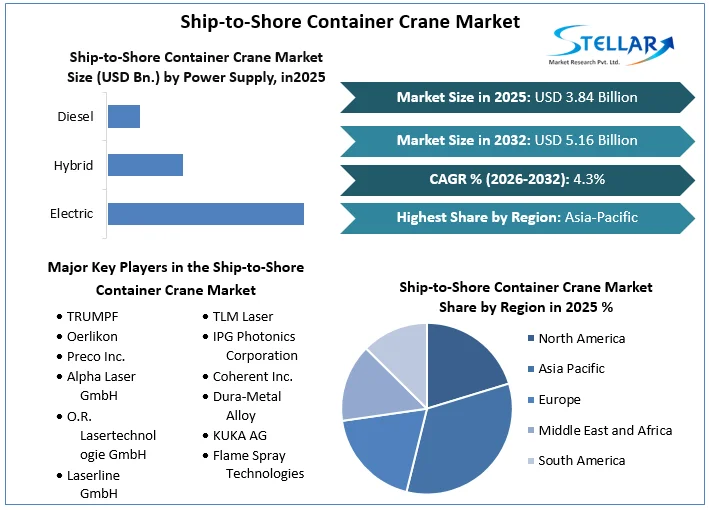
PUNE, India, June 19, 2026 – The Ship-to-Shore Container Crane Market, according to a recent study by Stellar Market Research, is entering a new growth cycle driven by rising containerized trade, port modernization programs, and increasing investments in automated terminal infrastructure. The market was valued at USD 3.84 billion in 2025 and is projected to reach USD 5.16 billion by 2032, expanding at a CAGR of 4.3% during the forecast period. As global supply chains adapt to larger vessels, growing cargo volumes, and sustainability mandates, ship-to-shore (STS) container cranes are becoming a strategic component of next-generation port operations.
Market Opportunity Overview
Global maritime trade is undergoing a structural transformation. Container ports are facing increasing pressure to improve turnaround times, reduce congestion, and accommodate ultra-large container vessels. This shift is creating significant demand for advanced STS cranes with longer outreach, higher lifting capacities, and integrated automation capabilities.
The market is increasingly influenced by investments in smart ports, digital terminal management systems, and electrified cargo-handling equipment. Governments and port operators are prioritizing infrastructure upgrades to strengthen trade competitiveness while reducing carbon emissions. As a result, crane manufacturers are expanding their portfolios to include automated, electric-powered, and remotely operated solutions that improve productivity while supporting environmental objectives.
𝐃𝐨𝐰𝐧𝐥𝐨𝐚𝐝 𝐅𝐫𝐞𝐞 𝐏𝐃𝐅 𝐁𝐫𝐨𝐜𝐡𝐮𝐫𝐞: https://www.stellarmr.com/report/req_sample/Ship-to-Shore-Container-Crane-Market/1196
Key Findings from the Report
-
The global Ship-to-Shore Container Crane Market was valued at USD 3.84 billion in 2025.
-
The market is forecast to reach approximately USD 5.16 billion by 2032, growing at a CAGR of 4.3%.
-
Electric-powered cranes represent the dominant power supply segment due to lower operating costs and growing sustainability requirements.
-
The hybrid crane segment is expected to witness accelerated adoption as ports seek operational flexibility and reduced emissions.
-
Cranes with greater than 60-meter outreach continue to gain demand due to increasing deployment of mega container vessels.
-
Asia-Pacific holds the largest market share, supported by extensive port expansion projects across China, India, South Korea, and Southeast Asia.
-
Rising investments in port automation and terminal digitalization are creating attractive opportunities for infrastructure investors and equipment suppliers.
Market Drivers and Restraints
Key Drivers
Expansion of Global Container Trade
Growing international trade volumes and increasing container throughput continue to drive demand for efficient cargo-handling infrastructure. Ports are investing heavily in equipment modernization to maintain competitiveness and reduce vessel turnaround times.
Rise of Mega Container Vessels
Shipping lines are deploying larger vessels to improve economies of scale. These vessels require cranes with extended outreach capabilities and higher lifting performance, encouraging replacement and upgrade cycles across global ports.
Automation and Smart Port Development
The adoption of automated terminals, remote crane operations, AI-enabled monitoring systems, and predictive maintenance technologies is increasing demand for advanced STS crane solutions.
Key Restraints
High Capital Investment Requirements
STS cranes represent a significant infrastructure investment, creating barriers for smaller ports and developing economies.
Economic and Trade Uncertainty
Geopolitical tensions, trade disruptions, and fluctuations in global cargo volumes can delay capital expenditure decisions and port expansion projects.
Technology, Regulation, and Sustainability Trends
Port operators worldwide are accelerating the transition toward low-emission infrastructure. Electric and hybrid-powered STS cranes are gaining traction as ports align with decarbonization targets and environmental regulations.
Automation technologies such as digital twins, IoT-enabled sensors, AI-driven predictive maintenance, and remote-control systems are improving operational efficiency while reducing labor dependency. Regulatory frameworks supporting green ports and sustainable logistics networks are encouraging investments in energy-efficient equipment.
Many ports are integrating renewable energy systems, shore power infrastructure, and electrified cargo-handling operations, reinforcing demand for modern crane fleets capable of meeting future sustainability requirements.
Regional Insights
Asia-Pacific Leads Global Demand
Asia-Pacific remains the largest market for ship-to-shore container cranes due to its dominant position in global manufacturing and maritime trade. China continues to invest aggressively in port modernization, while India’s port-led development initiatives and Southeast Asia’s logistics expansion are creating sustained equipment demand.
Middle East and Latin America Emerge as Growth Centers
The Middle East is witnessing increasing investments in transshipment hubs and logistics corridors, particularly across GCC countries. Meanwhile, Latin American ports are expanding capacity to support rising regional trade and accommodate larger vessels. Panama Canal-related traffic growth continues to influence infrastructure upgrades across the region.
Recent Industry Developments
Konecranes (2025): Expanded its automated container-handling portfolio with enhanced digital monitoring and predictive maintenance solutions, improving terminal productivity and reducing downtime.
Liebherr (2025): Secured multiple contracts for high-performance STS cranes featuring energy-efficient drive systems designed to support port decarbonization strategies.
ZPMC (2025): Increased deliveries of automated STS cranes to major Asian and Middle Eastern terminals, strengthening its position in large-scale port automation projects.
DP World (2025): Continued investments in smart-port technologies and automated terminal operations, driving demand for next-generation crane systems across global facilities.
Government of India (2025): Accelerated port modernization and logistics infrastructure initiatives under maritime development programs, supporting equipment procurement and terminal expansion activities.
𝐃𝐨𝐰𝐧𝐥𝐨𝐚𝐝 𝐅𝐫𝐞𝐞 𝐏𝐃𝐅 𝐁𝐫𝐨𝐜𝐡𝐮𝐫𝐞: https://www.stellarmr.com/report/req_sample/Ship-to-Shore-Container-Crane-Market/1196
Competitive Landscape
The Ship-to-Shore Container Crane Market remains moderately consolidated, with competition centered on automation capabilities, energy efficiency, lifting capacity, and lifecycle service offerings.
Leading companies include ZPMC, Konecranes, Liebherr, Kalmar, SANY Group, Noell Crane Systems, Wison Group, Weihua Group, and Anupam Industries. Market participants are pursuing strategic partnerships, technology upgrades, digital service expansion, and regional manufacturing investments to strengthen their market positions.
Analyst Commentary
“The next generation of port competitiveness will be defined by automation, sustainability, and operational resilience. Ship-to-shore cranes are no longer simply cargo-handling assets; they are becoming digital infrastructure platforms that enable higher throughput, lower emissions, and smarter terminal operations,” said a Senior Research Analyst at Stellar Market Research.
Future Outlook
The Ship-to-Shore Container Crane Market is expected to benefit from sustained investments in global trade infrastructure through 2032. Demand will increasingly shift toward automated, electric-powered, and digitally connected crane systems capable of supporting larger vessels and complex logistics operations.
Growing emphasis on supply chain resilience, green port development, and terminal productivity improvements will encourage continued investment from port authorities, logistics operators, and infrastructure funds. Manufacturers that successfully integrate automation, energy efficiency, and data-driven services into their offerings are expected to gain a competitive advantage throughout the forecast period.
About Stellar Market Research
Stellar Market Research is a global market research and business consulting firm delivering actionable intelligence across industrial, manufacturing, technology, healthcare, consumer goods, and energy sectors. The company provides comprehensive market assessments, competitive benchmarking, strategic forecasting, and growth opportunity analysis that help organizations make informed business decisions. Through rigorous primary and secondary research methodologies, Stellar Market Research delivers reliable insights that support investors, policymakers, and corporate leaders in navigating rapidly evolving global markets. Its industry-focused research solutions are designed to identify emerging trends, assess competitive dynamics, and enable long-term business growth.
Media Contact
Stellar Market Research
Website: http://stellarmr.com
Email: sales@stellarmr.com


