
Key Highlights
-
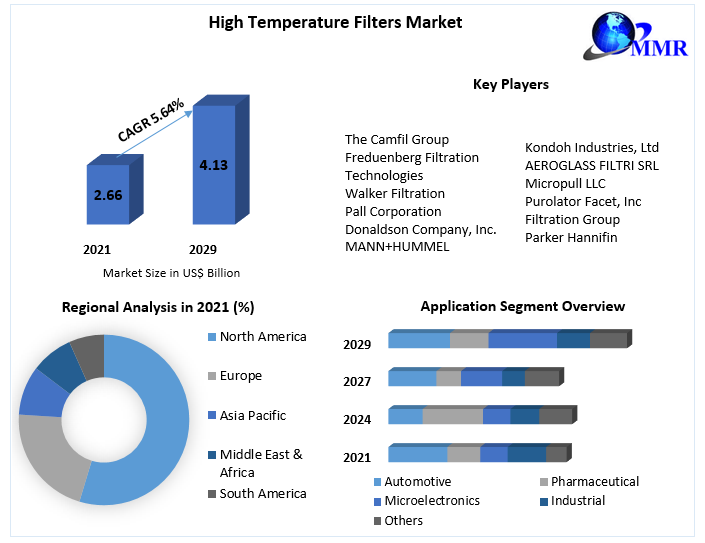
The global high temperature filters market valued at USD 2.66 billion in 2021 is projected to reach USD 4.13 billion by 2029, sustained by a stable CAGR of 5.64%.
-
Industrial filtration requirements exceeding 350 degrees Celsius drive hardware procurement across capital-intensive sectors.
-
The automotive sector emerged as the dominant segment in 2021, propelled by strict environmental mandates and continuous clean air needs in surface coating facilities.
-
Asia Pacific maintains technology and volume leadership, with China, India, Japan, and South Korea executing aggressive industrial localization strategies.
-
High barriers to entry persist for new market participants due to specialized infrastructure demands and the prohibitive cost of advanced filtration technologies.
Why This Matters Now Precision manufacturing ecosystems face unprecedented operational challenges as production processes push thermal and chemical boundaries. Industrial facilities require advanced contamination control systems that survive continuous exposure to extreme temperatures without structural degradation or outgassing. High-temperature filtration solutions operating at 350 degrees Celsius and above have evolved from auxiliary hardware into critical infrastructure elements necessary to maintain yield metrics.
Developing economies are aggressively shifting toward localized manufacturing networks to minimize external supply chain disruptions and mitigate import dependencies. This structural realignment forces heavy investments into modern production facilities that comply with stringent environmental emission caps and occupational safety rules. Clean air infrastructure must simultaneously maximize throughput and eliminate volatile or particulate micro-contaminants, making high-temperature thermal filtration a strategic priority for facility operators worldwide.
Market Overview The global high temperature filters market represents a specialized segment of the industrial purification sector, serving environments where standard filtration media would fail immediately. Industrial manufacturing facilities utilize these specialized systems to filter gaseous emissions, ambient cleanroom air, and liquid chemical streams under intense thermal stress. The structural integrity of these units prevents media breakdown, ensuring consistent particulate capturing efficiency even during rapid thermal cycling.
The total market valuation stood at USD 2.66 billion in 2021 and is on track to achieve a USD 4.13 billion valuation by 2029. This growth represents a 5.64% compound annual growth rate over the eight-year forecast period. While high technological deployment costs and technical infrastructure deficits present entry barriers for emerging manufacturers, the non-negotiable requirement for high-purity processing environments sustains ongoing commercial demand.
Key Trends Driving Growth A primary catalyst propelling the market is the global expansion of the petrochemical and chemical manufacturing sectors. These processing plants run continuous, high-temperature catalytic reactions and synthesis procedures that generate corrosive, heated gas streams. Deploying robust filters ensures that intermediate process gases are purified before recycling or venting, which protects downstream machinery from premature wear and minimizes hazardous industrial emissions.
Simultaneously, the global push toward supply chain sovereignty has transformed regional industrial investment patterns. Developing nations are actively backing the expansion of domestic manufacturing hubs through direct capital injections and favorable regulatory policies. This transition from import-reliant economic models to self-sustaining industrial production requires the construction of new fabrication plants, foundries, and processing lines, all of which require specialized thermal filtration architectures from day one.
Segment Insights
-
Automotive (Dominant Segment): This application vertical secured the leading market position in 2021 due to the massive scale of vehicle production and the strict quality parameters governing paint spraying booths. Paint curing and coating application processes require an unyielding, high-volume flow of fresh, contaminant-free air to prevent surface blemishes and meet safety and environmental compliance standards.
-
Microelectronics (Fastest-Growing Segment): Emerging as a critical expansion frontier, this application area is propelled by the escalating complexity of semiconductor fabrication and electronic component manufacturing. Sub-nanometer lithography and high-temperature wafer processing steps tolerate zero ambient particulate interference, necessitating specialized high-temperature air and gas filtration solutions to maximize substrate yields.
-
Liquid and Gas Filters (Product Segment): This category captures significant industrial procurement budgets due to the continuous filtration needs of high-velocity process streams within chemical, oil, and gas operations.
-
Air Filters (Product Segment): Driven by stringent cleanroom classification standards and emission monitoring mandates, air filtration units maintain consistent deployment across industrial baking, pharmaceutical sterilization, and microelectronics cleanrooms.
Regional Growth Story The Asia Pacific region commanded the dominant market share in 2021 and maintains its position as the primary engine of global market expansion. This regional dominance stems from a massive concentration of well-established industrial manufacturing hubs and intensive capital spending on new production lines. Within this region, China holds the single largest market share, powered by its expansive industrial infrastructure across chemicals, specialized ink production, and protective paint coatings.
Other key Asian economies are matching this momentum with targeted sectoral developments. Japan is generating significant procurement demand for high-temperature filtration systems, specifically driven by modernization programs within its domestic power generation facilities. India and South Korea are accelerating their local production capacities across heavy industries and electronics manufacturing, creating sustained demand for reliable thermal purification systems. Meanwhile, Europe maintains the second-largest global market share, supported by stringent regional environmental directives and advanced automotive manufacturing infrastructure.
Competitive Landscape The global high temperature filters market is highly consolidated, led by a select group of engineering firms with deep material science capabilities and established global distribution networks. Industry leaders focus on developing proprietary, high-durability filter media that can withstand prolonged thermal exposure without shedding fibers or losing structural integrity. Companies like The Camfil Group and Freudenberg Filtration Technologies continuously refine their product portfolios to address the dual challenges of reducing operational pressure drops and extending the service life of high-temperature filter elements.
This concentrated competitive environment forces market participants to differentiate through comprehensive application engineering rather than simple component supply. Providers like Walker Filtration, Pall Corporation, and Donaldson Company, Inc. actively align their product development pipelines with the evolving needs of heavy industrial plants and microelectronics cleanrooms. Success in this marketplace requires deep technical alignment with global engineering standards, forcing companies such as MANN+HUMMEL, Kondoh Industries, Ltd, and Parker Hannifin to invest heavily in specialized testing environments to validate filter performance under extreme thermal duress.
Recent Developments
-
Strategic capital investments by Tier-1 filtration providers focus on expanding production lines for glass-fiber and ceramic-based filter elements capable of continuous operation above 350 degrees Celsius.
-
Manufacturers are integrating advanced structural reinforcement techniques into high-temperature air filters to prevent media deformation under high-velocity industrial airflows.
-
Regional regulatory changes regarding industrial stack emissions have triggered a wave of retrospective system upgrades across power generation and chemical processing plants globally.
Strategic Implications The transition toward localized high-tech manufacturing ecosystems introduces significant operational variables for factory designers and procurement executives. Choosing filtration components directly impacts overall equipment effectiveness, energy consumption metrics, and unexpected facility downtime. Suboptimal filtration selections in high-temperature environments elevate the risk of sudden media failure, which can contaminate entire production batches and halt capital-intensive assembly operations.
Consequently, manufacturing enterprises must view thermal filtration procurement as a long-term operational strategy rather than a simple capital expense. As environmental emission mandates tighten globally, the capability to efficiently remove microscopic particulates from heated exhaust streams protects organizations from regulatory penalties and potential operational shutdowns. Strategic partnerships between industrial operators and filtration technology innovators are becoming essential to ensure systems are engineered precisely for specific thermal profiles.
Future Outlook The trajectory of the high temperature filters market will be shaped by the convergence of strict environmental compliance frameworks and the growth of high-precision manufacturing. Facilities will increasingly demand filtration units that deliver prolonged operational life cycles under extreme thermal and chemical duress. This structural evolution will reward filtration component manufacturers that consistently deliver zero-defect performance levels in highly volatile, high-heat operating environments.
Ultimately, the market will experience a clear operational dividing line based on technological adaptation. Industrial operators who integrate advanced, high-durability thermal filtration architectures into their production facilities will secure superior yield optimization, continuous uptime, and seamless regulatory compliance. Conversely, legacy manufacturing plants that rely on outdated, low-tolerance purification components will face escalating maintenance overhead, frequent production interruptions, and diminishing competitiveness on the global stage.
Analyst Perspective
“The global realignment of manufacturing infrastructure demands an entirely new standard of thermal process control,” states Neha Nalawade, Research Analyst at Maximize Market Research. “As developing economies scale up domestic production capabilities to reduce external supply dependencies, high temperature filters operating at 350 degrees Celsius and above have transitioned into critical operational necessities. Organizations that proactively upgrade their cleanroom and process filtration architectures will insulate themselves against catastrophic yield losses and volatile regulatory changes.”
About Maximize Market Research
Maximize Market Research Pvt. Ltd. (MMR) is a global market research and consulting company that provides reliable, data-focused, and practical business insights. The firm serves a wide range of industries, including healthcare, pharmaceuticals, technology, automotive, electronics, chemicals, personal care, and consumer goods. Through market forecasts, competitive analysis, strategic consulting, and industry impact assessments, MMR helps organizations understand changing market conditions, identify growth opportunities, and make informed business decisions for long-term success.
2nd Floor, Navale IT Park Phase 3
Pune Banglore Highway, Narhe
Pune, Maharashtra 411041, India
+91 9607365656
sales@maximizemarketresearch.com

