
Key Highlights
-
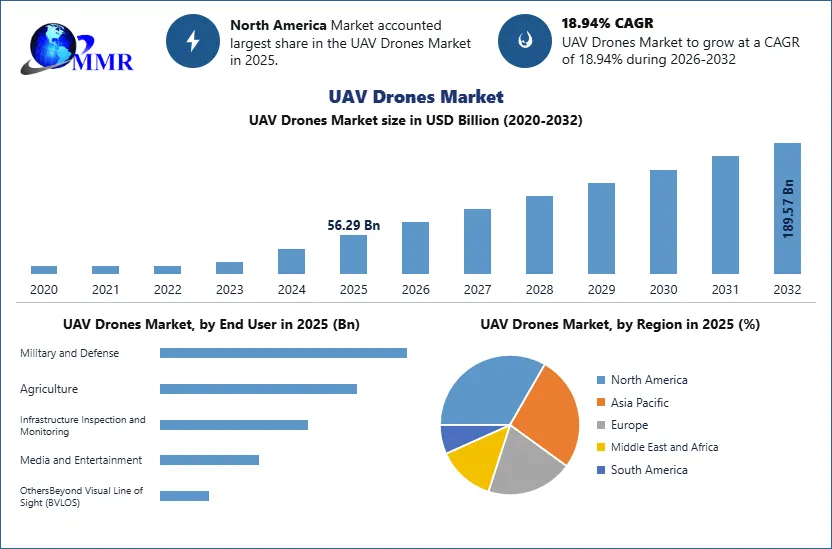
The global UAV Drones Market is projected to hit USD 189.57 billion by 2032, up from USD 56.29 billion in 2025, processing a consistent CAGR of 18.94%.
-
Artificial intelligence and machine learning integration are transforming basic remote platforms into fully autonomous flight systems requiring advanced onboard compute blocks.
-
Fixed-wing configurations captured the dominant market share in 2025 due to long-range operating efficiencies and expanding payload capabilities.
-
Precision agriculture applications are yielding up to a 5% increase in crop output, accelerating the deployment of specialized drone hardware in agrarian economies.
-
Regulatory frameworks, pilot certification mandates, and localized airspace congestion represent the primary operational headwinds suppressing manufacturing speed.
Why This Matters Now The fast-paced transformation of the UAV Drones Market has shifted from basic remote piloting to highly complex autonomous execution. For semiconductor fabs, component foundries, and electronic OEMs, this transition represents an immediate volume opportunity for high-performance silicon processing units. Drones are no longer simple mechanical assemblies; they are airborne edge data centers processing high-frequency data streams under intense power constraints.
As industrial and commercial demand scales up, the pressure mounts on component supply chains to supply advanced sensor configurations, optimized neural processing units, and high-density power modules. Executives and technology investors who align their component production with autonomous navigation requirements stand to secure multi-year supply contracts, while legacy providers risk marginalization.
Market Overview The global UAV Drones Market reached a valuation of USD 56.29 billion in 2025 and is on track to hit USD 189.57 billion by 2032. This trajectory represents a compound annual growth rate (CAGR) of 18.94% over the forecast window. The fundamental change driving this expansion is the migration from human-dependent control systems to software-driven autonomous operations. Drones are increasingly deployed in hazardous or vast topographies where traditional human observation is either costly or logistically unfeasible.
The baseline expansion relies heavily on structural innovations across the electronics ecosystem. Component miniaturization enables compact, highly agile drone frameworks to house dense sensor architectures without sacrificing flight time. Improved power-to-weight ratios, achieved through advanced electronics manufacturing services, allow commercial fleets to carry specialized payloads across logistics networks, infrastructure inspection paths, and public safety corridors, permanently altering commercial transport economics.
Key Trends Driving Growth The widespread adoption of artificial intelligence (AI) and machine learning (ML) technologies serves as the primary technical catalyst within the global market landscape. Onboard computer vision technology acts as the structural foundation for modern drone intelligence, executing real-time object detection, precise classification, and threat tracking directly at the edge. By running neural networks locally on specialized processors, modern UAVs can identify navigation hazards and modify flight trajectories on the fly without relying on high-latency cloud feedback loops.
Concurrently, commercial demands are shifting toward multi-sensor payloads that combine optical, thermal, and multispectral imaging technologies. In the precision agriculture sector, drones equipped with Normalized Difference Vegetation Index imaging provide actionable plant health insights that outperform conventional satellite data in both resolution and delivery speed. This shift from manual observation to localized, real-time data synthesis fuels continuous requirements for high-bandwidth logic chips and dense storage modules, forcing subsystem suppliers to iterate rapidly.
𝐃𝐨𝐰𝐧𝐥𝐨𝐚𝐝 𝐏𝐃𝐅 𝐁𝐫𝐨𝐜𝐡𝐮𝐫𝐞 @ https://www.maximizemarketresearch.com/request-sample/2632/
Segment Insights
-
Fixed-wing UAV Drones (Dominant Segment): This architecture secured the largest market share in 2025. The dominance is tied directly to the structural advantages of fixed-wing design, which offers significantly longer flight durations and wider area coverage than rotary alternatives. The ongoing manufacturing shift toward integrating Vertical Takeoff and Landing (VTOL) functionality eliminates legacy runway constraints, widening industrial applications across remote monitoring setups.
-
AI-Enabled and Hybrid Systems (Fastest-Growing Segment): Driven by the immediate enterprise requirement for autonomous flight operations, hybrid configurations that merge fixed-wing endurance with rotary agility are expanding fastest. The rapid deployment of autonomous flight algorithms across these systems accelerates the consumption of advanced processing chips, pushing foundries to increase production yields for edge-AI processing components.
Regional Growth Story North America maintains a highly organized footprint in the commercial drone environment, heavily backed by mature logistics infrastructure and early corporate adoption of automated inspection frameworks. The regional focus centers on establishing sophisticated airspace management systems to resolve ongoing urban congestion challenges, which incentivizes massive investment from major enterprise technology providers and specialized aerospace chip designers.
Asia-Pacific is emerging as a high-volume manufacturing powerhouse and a crucial deployment hub, with nations like India experiencing significant structural transformation. Given that agriculture serves as an economic anchor in India, government certification schemes, financial subsidies, and dedicated grants are driving rapid drone adoption across rural territories. This localized demand for affordable, resilient agricultural hardware stimulates electronics manufacturing activity across regional fabrication facilities, transforming the APAC supply chain into a critical source of specialized sensor components and ruggedized control systems.
Competitive Landscape The competitive field in the UAV Drones Market is transitioning from basic aerodynamic design rivalry toward a deep technological race centered on system intelligence and processing edge. Tier-one hardware providers are actively establishing partnerships with chip designers and fabless developers to integrate specialized machine learning engines directly into standard drone architectures. This trend underscores that long-term market leadership belongs to companies capable of optimizing the intersection of software efficiency and silicon performance.
Furthermore, manufacturing competitiveness is directly tied to supply chain control and access to advanced semiconductor capacity. As geopolitical entities push for semiconductor sovereignty, leading drone manufacturers are diversifying their component sources to avoid systemic disruption. Companies are competing fiercely on their ability to build secure, low-latency communication modules and highly resilient power distribution networks, ensuring their fleets operate safely under complex regional airspace regulations.
Recent Developments
-
Advanced drone platforms are deploying neural network structures locally to run real-time predictive weather modeling and atmospheric analysis, improving overall flight safety in volatile environments.
-
Manufacturing lines are increasingly embedding complex multispectral sensors directly into standard industrial kits, cutting down on third-party integration friction for end-users.
-
State-level regulatory changes are focusing on establishing rigid pilot certification and strict drone registration workflows, driving commercial operators to invest in automated data-logging technologies.
-
Specialized precision agriculture systems are demonstrating documented crop yield improvements of up to 5%, justifying larger upfront capital allocations from enterprise farming operations.
Strategic Implications The current market direction signals a fundamental shift in how industrial data is harvested and processed, directly impacting electronic component design strategies. Component developers can no longer treat drones as simple consumer gadgets; they must design systems that handle massive processing workloads under tight thermal and structural limits. This requires building highly specialized, low-power integrated circuits that manage complex flight physics and heavy camera data processing concurrently.
For electronics original equipment manufacturers (OEMs), building long-term supply chain resilience is now a critical business priority. Ongoing regulatory hurdles regarding data privacy and airspace security mean that hardware must feature built-in, hardware-level encryption and reliable fail-safe mechanisms. Enterprise buyers are prioritizing platforms that demonstrate clear compliance with regional security standards, making robust electronic engineering a key competitive differentiator rather than a back-end checklist item.
Future Outlook As autonomous flight systems scale up globally, the market will increasingly depend on the seamless rollout of next-generation edge computing architectures and unified airspace coordination tools. The continuous push for longer flights and larger cargo capacities will require significant upgrades in battery management systems and power distribution chips. This evolution will open up new monetization models around specialized commercial applications, autonomous freight shipping, and real-time security management. Ultimately, the market will reward agile developers who successfully embed cognitive processing blocks into energy-efficient aerial systems, while legacy manufacturers relying on external computing architectures will face decreasing margins and shrinking market share.
Analyst Perspective “The rapid scaling of the UAV Drones Market is creating an unprecedented volume surge for advanced electronic components and edge-AI processing blocks,” states Alpana Patil, Research Analyst at Maximize Market Research. “Drones have rapidly evolved into sophisticated, airborne data platforms. Success in this highly competitive space is no longer just about aerodynamic efficiency—it depends on software-hardware integration, sensor optimization, and navigating complex regional airspace frameworks.”
About Maximize Market Research
Maximize Market Research Pvt. Ltd. (MMR) is a global market research and consulting company that provides reliable, data-focused, and practical business insights. The firm serves a wide range of industries, including healthcare, pharmaceuticals, technology, automotive, electronics, chemicals, personal care, and consumer goods. Through market forecasts, competitive analysis, strategic consulting, and industry impact assessments, MMR helps organizations understand changing market conditions, identify growth opportunities, and make informed business decisions for long-term success.
2nd Floor, Navale IT Park Phase 3
Pune Banglore Highway, Narhe
Pune, Maharashtra 411041, India
+91 9607365656
sales@maximizemarketresearch.com

