Key Highlights
-
Dominant Segment: Battery Electric Vehicles (BEVs) lead the market share, favored for their zero-tailpipe-emission profile and increasing price parity with internal combustion engine (ICE) vehicles.
-
Fastest-Growing Segment: Commercial and last-mile delivery fleet electrification is accelerating, as logistics companies look to reduce operating costs and meet sustainability mandates.
-
Regional Leadership: Market growth is concentrated in states with aggressive zero-emission vehicle (ZEV) mandates and robust public-private investments in charging corridors.
-
Technology Shift: A migration toward integrated software-defined vehicle architectures and standardized high-speed charging (NACS) is reducing user friction and expanding the addressable consumer base.
Why This Matters Now
The convergence of federal policy (e.g., IRA tax credits) and infrastructure deployment (e.g., the national NEVI program) has turned EV ownership from a niche preference into a pragmatic economic choice for many Americans. As automakers pivot away from legacy ICE platforms to dedicated EV architectures, the U.S. market is seeing an influx of budget-friendly models and high-utility electric trucks/SUVs. For stakeholders, this requires a focus on grid resilience, supply chain localization, and the seamless integration of public charging networks.
Market Overview
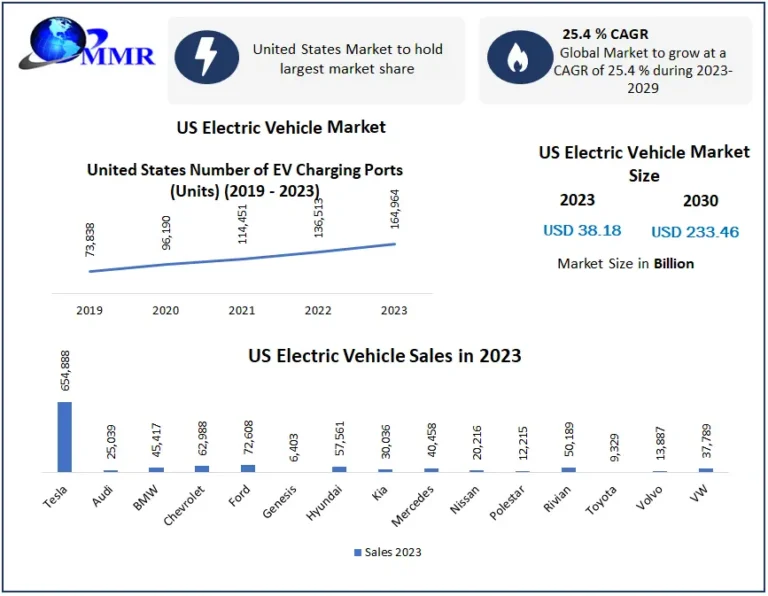
Valued at USD 38.18 billion in 2023, the U.S. EV market is projected to reach USD 233.46 billion by 2030, growing at a CAGR of 25.4%. The industry is underpinned by a transition from standalone vehicle sales to comprehensive “mobility ecosystems.” As manufacturers localize battery sourcing and assembly to meet stringent IRA requirements, the market is experiencing a fundamental shift in how vehicles are priced, manufactured, and serviced.
Key Trends Driving Growth
-
Charging Standardization: The widespread adoption of the North American Charging Standard (NACS) is mitigating range anxiety and fragmenting the previous siloed charging infrastructure, greatly enhancing consumer convenience.
-
Localized Supply Chains: Stricter requirements for domestic battery assembly and mineral sourcing are forcing OEMs to relocate production capacity within North America.
-
Fleet Electrification: The electrification of commercial and public transportation is providing a stable, high-volume growth segment that is less sensitive to consumer-driven market volatility.
Segment Insights
-
Passenger Vehicles (Dominant Segment): Remain the backbone of the market, fueled by increasing model diversity, improved battery range, and significant federal/state-level purchasing incentives.
-
Commercial Vehicles (Fastest-Growing Segment): Seeing high adoption in urban logistics, where lower maintenance costs and energy efficiency provide a clear total-cost-of-ownership (TCO) advantage over diesel alternatives.
-
SUV/Crossover Segment: Continues to capture the largest share of consumer interest, reflecting broader U.S. automotive trends toward larger, versatile, and high-clearance vehicle body types.
Regional Growth Story
-
Coastal Hubs: California and the Northeast continue to lead in adoption rates, supported by early-mover government mandates and higher investment in private and public charging networks.
-
Emerging Corridors: Growth is expanding rapidly across the “Battery Belt” and major highway corridors, as federal funding (NEVI) accelerates the development of DC fast-charging stations along alternative fuel routes.
Competitive Landscape
The competitive landscape is defined by the continued dominance of Tesla and the aggressive pivot of legacy domestic automakers (Ford, GM) and new-entrant innovators (Rivian, Lucid). Success is increasingly tied to the maturity of the software ecosystem, the ability to secure domestic battery supply, and the integration into reliable public charging networks.
Recent Developments
-
NACS Transition: Almost all major OEMs have pledged to adopt NACS, effectively creating a unified charging experience that promises to stabilize consumer demand.
-
Battery Chemistry Innovation: Rapid shift toward LFP (Lithium Iron Phosphate) batteries for entry-level models to improve affordability, alongside high-nickel chemistries for performance segments.
-
Grid Integration: Early pilot programs for Vehicle-to-Grid (V2G) technology, positioning EVs as essential assets for home energy storage and grid balancing during peak demand.
Strategic Implications
For semiconductor and electronics leaders, the U.S. EV market is the essential “Power Intelligence” layer. Suppliers that can provide integrated power modules, smart BMS (Battery Management System) controllers, and reliable connectivity hardware will capture the bulk of the market value. Investing in automotive-grade reliability and fast-charging efficiency will be the key differentiator for securing design-ins with high-volume U.S. OEMs.
Future Outlook
The next phase of the U.S. EV market will be defined by “Autonomous Mobility Integration,” where EVs function not just as transportation but as software-managed assets capable of dynamic charging and grid-services participation, effectively bridging the gap between hardware ownership and sustainable, autonomous infrastructure.
Analyst Perspective “The U.S. EV market has reached a critical inflection point where infrastructure and model variety are finally catching up to consumer intent. The future belongs to OEMs who can master the transition to domestic battery supply chains while providing a seamless, software-first charging experience. Those who succeed will define the next century of American automotive dominance.” — Rucha Deshpande
About Maximize Market Research Maximize Market Research Pvt. Ltd. (MMR) is a global market research and consulting company that provides reliable, data-focused, and practical business insights. The firm serves a wide range of industries, including healthcare, pharmaceuticals, technology, automotive, electronics, chemicals, personal care, and consumer goods. Through market forecasts, competitive analysis, strategic consulting, and industry impact assessments, MMR helps organizations understand changing market conditions, identify growth opportunities, and make informed business decisions for long-term success.
2nd Floor, Navale IT Park Phase 3
Pune Banglore Highway, Narhe
Pune, Maharashtra 411041, India
+91 9607365656
sales@maximizemarketresearch.com
Report URL: https://www.maximizemarketresearch.com/market-report/us-electric-vehicle-market/63467/